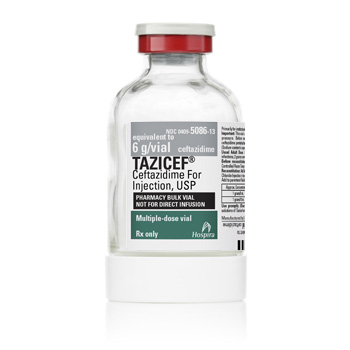
Ceftazidime
Ceftazidime
What is Ceftazidime?
Ceftazidime is a third-generation cephalosporin antibiotic effective against a broad spectrum of Gram-negative bacteria, including Pseudomonas aeruginosa. It is commonly used in the treatment of severe respiratory, urinary tract, skin, and intra-abdominal infections, particularly those that are hospital-acquired. Ceftazidime works by disrupting the synthesis of the bacterial cell wall, leading to cell death.
Side Effects
- Severe vomiting or stomach pain
- Diarrhea that may contain blood
- Allergic reaction: Itching or hives, swelling in your face or hands, swelling or tingling in your mouth or throat, chest tightness, trouble breathing
Warnings
- Tell any doctor or dentist who treats you that you are using this medicine. This medicine may affect certain medical test results.
- Tell your doctor if you are pregnant or breastfeeding, you had an allergic reaction to penicillin, you have kidney disease, liver disease, weak immune system, or you have a history of stomach or intestinal problems, including colitis.
- This medicine may prevent birth control pills from working correctly. Use a second form of birth control while you are using this medicine.
- This medicine can cause diarrhea. Call your doctor if the diarrhea becomes severe, does not stop, or is bloody. Do not take any medicine to stop diarrhea until you have talked to your doctor. Diarrhea can occur 2 months or more after you stop taking this medicine.
- Take all of the medicine in your prescription to clear up your infection, even if you feel better after the first few doses.
Prescription savings · · · ·
What is Ceftazidime ?
Ceftazidime is a third-generation cephalosporin antibiotic effective against a broad spectrum of Gram-negative bacteria, including Pseudomonas aeruginosa. It is commonly used in the treatment of severe respiratory, urinary tract, skin, and intra-abdominal infections, particularly those that are hospital-acquired. Ceftazidime works by disrupting the synthesis of the bacterial cell wall, leading to cell death.
- Severe vomiting or stomach pain
- Diarrhea that may contain blood
- Allergic reaction: Itching or hives, swelling in your face or hands, swelling or tingling in your mouth or throat, chest tightness, trouble breathing
- Swelling, pain, or redness near where your IV is located
- Blistering, peeling, red rash
- Tell any doctor or dentist who treats you that you are using this medicine. This medicine may affect certain medical test results.
- Tell your doctor if you are pregnant or breastfeeding, you had an allergic reaction to penicillin, you have kidney disease, liver disease, weak immune system, or you have a history of stomach or intestinal problems, including colitis.
- This medicine may prevent birth control pills from working correctly. Use a second form of birth control while you are using this medicine.
- This medicine can cause diarrhea. Call your doctor if the diarrhea becomes severe, does not stop, or is bloody. Do not take any medicine to stop diarrhea until you have talked to your doctor. Diarrhea can occur 2 months or more after you stop taking this medicine.
- Take all of the medicine in your prescription to clear up your infection, even if you feel better after the first few doses.
- Call your doctor if your symptoms do not improve or if they get worse.
- Keep all medicine out of the reach of children. Never share your medicine with anyone.
Ceftazidime Coupons & Prices
Ceftazidime
4 ED medications in one dose
Apomorphine, sildenafil, tadalafil & vardenafil · One sublingual dose · Free express shipping
Ceftazidime prices by dosage
Lowest cash price with a free Rx.com coupon vs. the average retail price.
| Dosage | Quantity | Retail price | Rx.com price |
|---|---|---|---|
| 1gm · Solution Reconstituted | 1 | — | $7.95 |
| 2gm · Solution Reconstituted | 9 | $254.37 | $46.94 |
| 6gm · Solution Reconstituted | 1 | $35.00 | $33.52 |
Cash prices near ZIP 77433; updated regularly. Actual pharmacy price may vary.
Use a free Rx.com ceftazidime coupon to compare cash prices on this injectable antibiotic at more than 60,000 pharmacies nationwide. Ceftazidime is the generic form of the third-generation cephalosporin sold under brand names such as Fortaz and Tazicef, and because the generic is widely available, the cash price is usually far below the brand. Prices still vary a great deal from one pharmacy to the next, even in the same town, so it pays to compare. Enter your ZIP code above to see today's ceftazidime price near you and print, text, or email your coupon at no cost.
What is ceftazidime and how does it work?
Ceftazidime is a third-generation cephalosporin antibiotic, part of the beta-lactam family. It kills bacteria by interfering with the way they build their cell walls, so the bacteria cannot hold together and survive. It is best known for being active against Pseudomonas aeruginosa, a hard-to-treat bacterium, which is why it is a mainstay when doctors need broad anti-pseudomonal coverage.
Ceftazidime is given only by injection into a vein (IV) or into a muscle (IM), or as a premixed IV solution. There is no pill or liquid form you can swallow. The FDA has approved it for serious infections caused by susceptible bacteria, including lower respiratory tract infections such as pneumonia (including infections in people with cystic fibrosis), skin and skin-structure infections, urinary tract infections, bacterial septicemia, bone and joint infections, gynecologic infections, intra-abdominal infections such as peritonitis, and central nervous system infections including meningitis. Like all antibiotics, ceftazidime does not treat colds, the flu, or other viral illnesses.
Ceftazidime cost and how to save without insurance
Ceftazidime is available as an FDA-approved generic, so it is already one of the lower-cost options in its class compared with brand-name Fortaz or Tazicef. Even so, the cash price for the same vial and the same strength can differ widely from pharmacy to pharmacy, which is exactly why comparing before you fill matters. Rx.com checks prices across more than 60,000 pharmacies and shows you the discounted cash price at each one.
A few honest notes if you are paying without insurance. Ceftazidime is an injectable drug, so it is often given in a hospital, clinic, or infusion center, and in that setting it is billed as part of your care rather than picked up at a retail counter. If your prescriber sends ceftazidime to a retail or home-infusion pharmacy, a discount coupon can be used there. There is no manufacturer savings card for generic ceftazidime. Our coupon is free, requires no membership, and can be used instead of insurance if the cash price is lower. Enter your ZIP above to see today's price near you.
Ceftazidime vs. other cephalosporins and alternatives
Cephalosporins are grouped by "generations," and each generation covers a somewhat different set of bacteria. Your prescriber picks one based on the infection, the likely bacteria, your allergy history, and your kidney function. Ceftazidime's distinguishing feature is its anti-pseudomonal activity.
- Cefepime is a fourth-generation cephalosporin that also covers Pseudomonas and adds more coverage of certain gram-positive bacteria.
- Ceftriaxone is a third-generation cephalosporin used very widely, but it is not reliable against Pseudomonas. It can often be given once a day.
- Cefotaxime is another third-generation injectable cephalosporin without anti-pseudomonal coverage.
- Cefazolin is a first-generation cephalosporin used mainly for skin infections and surgical prevention.
- Cefuroxime is a second-generation cephalosporin available in both injectable and oral forms.
- Ciprofloxacin is a fluoroquinolone (a different class) that also has activity against Pseudomonas and comes in oral and IV forms.
Ceftazidime is also one half of the separate combination brand drug Avycaz (ceftazidime/avibactam), which pairs it with a beta-lactamase inhibitor. Avycaz is its own brand product and is not interchangeable with plain ceftazidime. These drugs are not swappable on your own, so never substitute one antibiotic for another without your prescriber.
Ceftazidime safety and side effects
Ceftazidime has no boxed warning, but there are important risks to know about. Serious allergic reactions, including anaphylaxis, can happen, so tell your care team about any prior reaction to a cephalosporin or penicillin. Cross-reactivity may occur in up to about 10% of people who are allergic to penicillin, so a careful allergy history is required before the first dose. Antibiotics such as ceftazidime can also cause Clostridioides difficile-associated diarrhea and pseudomembranous colitis, which can be serious and may appear up to two months after treatment ends. Report any watery or bloody diarrhea to your provider rather than treating it yourself.
Ceftazidime is cleared by the kidneys, and if it builds up in people with reduced kidney function it can cause neurologic problems such as seizures, nonconvulsive status epilepticus, encephalopathy, coma, asterixis, muscle twitching, or myoclonia. The dose must be lowered based on creatinine clearance, so your kidney function should be checked. Other reported effects include injection-site pain or vein irritation, rash, transient increases in liver enzymes, rare hemolytic anemia and other blood problems (prothrombin time may be monitored in at-risk patients), severe skin reactions such as Stevens-Johnson syndrome, toxic epidermal necrolysis, or DRESS, and overgrowth of organisms the drug does not cover. Kidney-injury risk goes up when ceftazidime is used with aminoglycoside antibiotics or potent diuretics, and ceftazidime may reduce the effectiveness of some oral contraceptives. Finish the entire prescribed course, even if you feel better. This page is general information, not medical advice; talk with your doctor or pharmacist about your own situation.
This Ceftazidime information was written and reviewed against authoritative U.S. medical sources — MedlinePlus (U.S. National Library of Medicine), DailyMed, and FDA prescribing information — and checked for accuracy. It is provided for education and is not a substitute for professional medical advice.
Verify the official label: Ceftazidime on DailyMed (FDA)
Reviewed against FDA labeling · Last reviewed July 2026
Related Drugs
Browse more medications: starting with C · full A-Z directory · by condition · common drugs
Medical disclaimer: This information is provided for general educational purposes only and is not medical advice. It is not a substitute for professional diagnosis or treatment. Always consult a licensed physician, pharmacist, or other qualified healthcare provider before starting, stopping, or changing any medication or treatment. Never disregard professional medical advice or delay seeking it because of something you read here. If you think you may have a medical emergency, call your doctor or 911 immediately.


