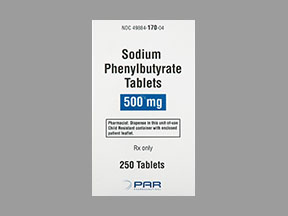
Sodium Phenylbutyrate
Sodium Phenylbutyrate 250 Tablets
What is Sodium Phenylbutyrate?
Buphenyl is a prescription medicine used for the management of high levels of ammonia in the blood caused by urea cycle disorder. Sodium phenylbutyrate is the generic version of Buphenyl. The average price of Buphenyl is around $14,236 for a supply of 250 g, 100% oral powder for reconstitution. Use our Rx.com savings offer to get great discounts on Buphenyl at participating pharmacies near you.Side Effects
- Numbness, tingling, or burning pain in your hands, arms, legs, or feet
- Sudden or severe stomach pain, nausea, vomiting, fever, lightheadedness
- Severe menstrual bleeding
Warnings
- Tell your doctor if you are pregnant or breastfeeding, or if you have kidney disease, liver disease, heart disease, edema (swelling), diabetes, or if you have a history of fructose intolerance, glucose-galactose malabsorption, or sucrase-isomaltase deficiency.
- This medicine may cause nerve problems.
- Your doctor will do lab tests at regular visits to check on the effects of this medicine. Keep all appointments.
- Keep all medicine out of the reach of children. Never share your medicine with anyone.
- Severe menstrual bleeding.
Prescription savings · · · ·
What is Sodium Phenylbutyrate ?
Buphenyl is a prescription medicine used for the management of high levels of ammonia in the blood caused by urea cycle disorder. Sodium phenylbutyrate is the generic version of Buphenyl. The average price of Buphenyl is around $14,236 for a supply of 250 g, 100% oral powder for reconstitution. Use our Rx.com savings offer to get great discounts on Buphenyl at participating pharmacies near you.- Numbness, tingling, or burning pain in your hands, arms, legs, or feet
- Sudden or severe stomach pain, nausea, vomiting, fever, lightheadedness
- Severe menstrual bleeding
- Swelling in your hand, ankles, or feet
- Unusual bleeding, bruising, or weakness
- Allergic reaction: Itching or hives, swelling in your face or hands, swelling or tingling in your mouth or throat, chest tightness, trouble breathing
- Confusion, headache, sleepiness, tiredness
- Decrease in how much or how often you urinate
- Dry mouth, increased thirst, muscle cramps, uneven heartbeat
- Severe vomiting or rectal bleeding
- Tell your doctor if you are pregnant or breastfeeding, or if you have kidney disease, liver disease, heart disease, edema (swelling), diabetes, or if you have a history of fructose intolerance, glucose-galactose malabsorption, or sucrase-isomaltase deficiency.
- This medicine may cause nerve problems.
- Your doctor will do lab tests at regular visits to check on the effects of this medicine. Keep all appointments.
- Keep all medicine out of the reach of children. Never share your medicine with anyone.
- Severe menstrual bleeding.
- Severe vomiting or rectal bleeding.
- Sudden or severe stomach pain, nausea, vomiting, fever, or lightheadedness.
- Swelling in your hand, ankles, or feet.
- Unusual bleeding, bruising, or weakness.
Sodium Phenylbutyrate Coupons & Prices
Sodium Phenylbutyrate 250 Tablets
4 ED medications in one dose
Apomorphine, sildenafil, tadalafil & vardenafil · One sublingual dose · Free express shipping
Use the free Rx.com sodium phenylbutyrate coupon to compare cash prices at more than 60,000 pharmacies before you fill. Sodium phenylbutyrate is the generic version of Buphenyl, a nitrogen-binding (ammonia-scavenging) medicine taken every day, alongside a protein-restricted diet, for the long-term management of certain urea cycle disorders. Because it is a lifelong therapy, even small differences in the cash price add up, and pharmacies in the same town can quote very different prices for the exact same tablets or powder. Enter your ZIP code above to see today's price near you and show the coupon at the counter.
What is sodium phenylbutyrate and how does it work?
Sodium phenylbutyrate is a nitrogen-binding, or ammonia-scavenging, agent. It is FDA-approved as add-on therapy for the chronic management of urea cycle disorders (UCDs) caused by a deficiency of carbamoyl phosphate synthetase (CPS), ornithine transcarbamylase (OTC), or argininosuccinic acid synthetase (AS). The label covers all patients with neonatal-onset disease (showing up in the first 28 days of life) and patients with late-onset disease who have had an episode of hyperammonemic encephalopathy. It is always used with dietary protein restriction and, where a specialist directs it, arginine or citrulline and other essential amino acids.
In a urea cycle disorder, the body cannot fully convert nitrogen waste into urea, so ammonia builds up in the blood. Sodium phenylbutyrate is a prodrug: the body converts it to phenylacetate, which joins with the amino acid glutamine to form phenylacetylglutamine. That compound carries nitrogen out of the body in the urine, giving waste nitrogen an alternate route that bypasses the broken urea cycle. Importantly, this is maintenance therapy. It is not a treatment for acute hyperammonemia, which is a medical emergency handled in a hospital with hemodialysis and IV therapy. In laboratory research the drug is also studied as a histone deacetylase (HDAC) inhibitor and a chemical chaperone, but those uses are investigational and are not approved indications.
Sodium phenylbutyrate cost and coupon savings
Sodium phenylbutyrate is available as an FDA-approved generic, and the generic is normally the lower-cost way to fill the prescription compared with the brand. That said, "generic" does not automatically mean cheap at every counter. Cash prices for the same strength, quantity, and form can vary widely from one pharmacy to the next, even between two stores a few miles apart, because each pharmacy sets its own cash price. That is exactly why comparing before you fill is worth the two minutes.
Rx.com compares cash prices across more than 60,000 pharmacies. Enter your ZIP code above to see today's price near you, then show the free coupon on your phone or a printout at the pharmacy counter. There is no membership, no fee, and no insurance needed. A few honest notes on paying without insurance: the coupon is a cash-discount price, so it does not run through your plan and it does not count toward a deductible, and you should compare it against your insurance copay and pick whichever is lower. The brand-name manufacturer of Buphenyl also runs a cost-assistance program on its own official website; eligibility, terms, and who can use it vary, so check the manufacturer's site directly. Patients with rare metabolic conditions can also ask their metabolic clinic's social worker or pharmacist about patient assistance foundations.
Sodium phenylbutyrate vs. other ammonia-lowering options
Sodium phenylbutyrate is sold under several brand names, and there are related nitrogen-binding drugs your metabolic specialist may consider. Which one is right depends on the specific enzyme deficiency, age, ability to swallow, sodium tolerance, and how well ammonia levels are controlled. Switching between these is a decision for the specialist who manages the urea cycle disorder, not a self-service swap.
- Buphenyl — the original brand of sodium phenylbutyrate, available as tablets and an oral powder.
- Pheburane — a taste-masked sodium phenylbutyrate oral pellet formulation.
- Olpruva — a sodium phenylbutyrate oral suspension packaged in single-dose envelopes.
- Glycerol phenylbutyrate, sold as Ravicti — a related nitrogen-binding liquid that is sodium-free, which matters for people who must limit sodium.
- Carglumic acid — a different kind of ammonia-lowering drug used for a different underlying enzyme problem, not a direct substitute.
High ammonia from advanced liver disease is a separate situation with separate treatments, such as lactulose; sodium phenylbutyrate is not a substitute there. Whatever you are prescribed, you can compare cash prices for the brand and the generic side by side on Rx.com before you fill.
Safety, side effects, and what to watch for
Sodium phenylbutyrate does not carry a boxed warning. The biggest practical issue is sodium: each 500 mg tablet contains roughly 62 mg of sodium (about 124 to 125 mg of sodium per gram of drug), which adds up quickly at therapeutic doses. It should be used with great caution, if at all, in congestive heart failure, severe kidney impairment, or any condition where the body holds on to sodium and swells. The drug can also cause low potassium (hypokalemia), which can be serious. Metabolic acidosis or alkalosis, high chloride, low phosphate, high uric acid, and high blood sodium have all been reported, and very high phenylacetate levels have been associated with nervous-system effects such as sleepiness, confusion, and lightheadedness. Because of this, therapy is monitored with regular plasma ammonia, amino acid, and electrolyte testing.
Common side effects include missed or irregular periods (reported in roughly 23% of menstruating patients), reduced appetite, a distinct body odor and a bad or altered taste (both from the phenylacetate metabolite), and stomach pain, nausea, or vomiting. Some medicines can raise ammonia or interfere with how the drug is cleared, including probenecid, corticosteroids, valproate, and haloperidol, so keep a full medication list with your care team. Sodium phenylbutyrate is meant to be managed by a metabolic specialist, is usually taken for life in urea cycle disorders, and only works alongside the prescribed protein-restricted diet. This page is general information, not medical advice; talk with your doctor or pharmacist about your own situation, and seek emergency care for symptoms of a hyperammonemic crisis such as vomiting, confusion, or unusual sleepiness.
This Sodium Phenylbutyrate information was written and reviewed against authoritative U.S. medical sources — MedlinePlus (U.S. National Library of Medicine), DailyMed, and FDA prescribing information — and checked for accuracy. It is provided for education and is not a substitute for professional medical advice.
Verify the official label: Sodium Phenylbutyrate on DailyMed (FDA)
Reviewed against FDA labeling · Last reviewed July 2026
Related Drugs
Browse more medications: starting with S · full A-Z directory · by condition · common drugs
Medical disclaimer: This information is provided for general educational purposes only and is not medical advice. It is not a substitute for professional diagnosis or treatment. Always consult a licensed physician, pharmacist, or other qualified healthcare provider before starting, stopping, or changing any medication or treatment. Never disregard professional medical advice or delay seeking it because of something you read here. If you think you may have a medical emergency, call your doctor or 911 immediately.


