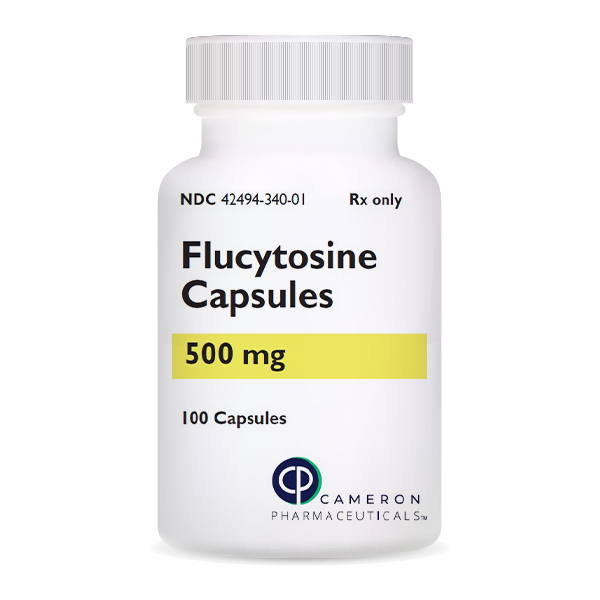
Flucytosine
Flucytosine
What is Flucytosine?
Flucytosine is an antifungal medication primarily used to treat serious fungal infections such as cryptococcal meningitis. It works by inhibiting fungal DNA synthesis, helping to stop the growth of fungi. Common side effects may include nausea, vomiting, and bone marrow suppression. Users can connect with a licensed provider through Rx.com to manage prescriptions and explore potential savings options.
Side Effects
- Numbness, tingling, or burning pain in your hands, arms, legs, or feet
- Unusual bleeding, bruising, or weakness
- Rapid weight gain, swelling in your hands, ankles, or feet
Warnings
- Tell your doctor if you are pregnant or breastfeeding, or if you have kidney disease, liver disease, blood or bone marrow problems, or a weak immune system.
- Your doctor will do lab tests at regular visits to check on the effects of this medicine. Keep all appointments.
- Keep all medicine out of the reach of children. Never share your medicine with anyone.
- If this medicine makes you dizzy or drowsy, avoid driving or using machinery.
- Yellowing of your skin or eyes
Prescription savings · · · ·
What is Flucytosine ?
Flucytosine is an antifungal medication primarily used to treat serious fungal infections such as cryptococcal meningitis. It works by inhibiting fungal DNA synthesis, helping to stop the growth of fungi. Common side effects may include nausea, vomiting, and bone marrow suppression. Users can connect with a licensed provider through Rx.com to manage prescriptions and explore potential savings options.
- Numbness, tingling, or burning pain in your hands, arms, legs, or feet
- Unusual bleeding, bruising, or weakness
- Rapid weight gain, swelling in your hands, ankles, or feet
- Tiredness, trouble breathing, uneven heartbeat
- Allergic reaction: Itching or hives, swelling in your face or hands, swelling or tingling in your mouth or throat, chest tightness, trouble breathing
- Dark urine or pale stools, nausea, vomiting, loss of appetite, stomach pain, yellow skin or eyes
- Dry mouth, increased thirst, muscle cramps
- Fever, chills, cough, sore throat, body aches
- Shaking, trembling, sweating, faintness or lightheadedness, hunger, confusion
- Tell your doctor if you are pregnant or breastfeeding, or if you have kidney disease, liver disease, blood or bone marrow problems, or a weak immune system.
- Your doctor will do lab tests at regular visits to check on the effects of this medicine. Keep all appointments.
- Keep all medicine out of the reach of children. Never share your medicine with anyone.
- If this medicine makes you dizzy or drowsy, avoid driving or using machinery.
- Yellowing of your skin or eyes
- Bloody urine or urinating less than one cup in a day
- Chest pain
Flucytosine Coupons & Prices
Flucytosine
4 ED medications in one dose
Apomorphine, sildenafil, tadalafil & vardenafil · One sublingual dose · Free express shipping
Flucytosine prices by dosage
Lowest cash price with a free Rx.com coupon vs. the average retail price.
| Dosage | Quantity | Retail price | Rx.com price |
|---|---|---|---|
| 250mg · Capsule | 100 | $6,985.99 | $919.14 |
| 500mg · Capsule | 60 | $11,473.96 | $1,212.60 |
Cash prices near ZIP 77433; updated regularly. Actual pharmacy price may vary.
Use a free flucytosine coupon from Rx.com to compare cash prices at more than 60,000 pharmacies before you fill. Flucytosine (brand name Ancobon) is a prescription antifungal capsule used to treat serious infections caused by susceptible strains of Candida and Cryptococcus. Its FDA label directs that it be used in combination with amphotericin B for systemic candidiasis and cryptococcosis, because resistance can emerge when flucytosine is used on its own. It is available as a generic, and what you pay without insurance can differ from one pharmacy to the next, so it is worth checking more than one. Enter your ZIP code above to see today's price near you and print, text, or email your coupon.
What is flucytosine and how does it work?
Flucytosine is a fluorinated pyrimidine antimetabolite antifungal. Once it gets inside a fungal cell, it is converted to 5-fluorouracil, which interferes with the fungus making DNA and RNA. Without those building blocks, the fungus cannot grow and multiply. It comes as oral capsules in 250 mg and 500 mg strengths, and dosing is based on body weight (the label describes 50 to 150 mg/kg per day, divided into doses every 6 hours), with lower doses or longer intervals for people whose kidneys are not clearing the drug normally.
The label indicates flucytosine only for serious infections caused by susceptible strains of Candida and/or Cryptococcus. For Candida, the label describes effective treatment of septicemia, endocarditis and urinary system infections, and says limited trials in pulmonary infections justify its use. For Cryptococcus, the label describes effective treatment of meningitis and pulmonary infections, and notes that studies in cryptococcal septicemia and urinary tract infections are limited although good responses have been reported. The label also directs that flucytosine be used in combination with amphotericin B for systemic candidiasis and cryptococcosis because of the emergence of resistance. Flucytosine is not used for superficial or minor fungal infections such as nail, skin or common yeast infections.
Flucytosine cost and coupons without insurance
Flucytosine is sold both under the brand name Ancobon (Bausch Health) and as a generic flucytosine capsule from several manufacturers. Flucytosine is not a routine, high-volume medicine, and cash prices for the same capsule strength and quantity can vary between a chain pharmacy, a grocery-store pharmacy and an independent pharmacy in the same town. Prices vary by pharmacy, so the only way to know what you would actually pay is to compare.
For people paying cash, the practical steps are to ask your prescriber and pharmacist which version is being dispensed, compare pharmacies, and bring a discount coupon. Rx.com's free coupon compares cash prices across more than 60,000 U.S. pharmacies. Enter your ZIP above to see today's price near you. A coupon is not insurance, it is a cash-discount price, and you cannot combine it with your insurance benefit on the same fill, so it is worth checking both and using whichever is lower. If cost is a barrier, tell your care team before you skip or stretch doses, because flucytosine is meant to be taken as part of a combination regimen and missed doses can let resistance develop.
Flucytosine vs. other antifungals
Flucytosine is not meant to be a stand-alone antifungal. Its FDA label directs that it be used in combination with amphotericin B for systemic candidiasis and cryptococcosis, because resistance to flucytosine can emerge when it is used by itself. So the honest comparison is not "flucytosine or something else" but where flucytosine fits inside a regimen your infectious-disease team designs.
Other antifungals your prescriber may use, alone or in sequence, work through a different mechanism than flucytosine:
- Fluconazole - an azole commonly used after induction therapy to consolidate and maintain treatment of cryptococcal disease.
- Itraconazole and voriconazole - azole antifungals used for other systemic fungal infections.
- Ketoconazole - an older oral azole now reserved for limited situations because of its safety profile.
Which one is right depends on the organism, the site of infection, your kidney and liver function, and your other medicines. That decision belongs with your prescriber, not with a price comparison.
Safety, warnings and monitoring
Flucytosine carries a boxed warning, and the box itself is short: use with extreme caution in patients with impaired renal function, and close monitoring of hematologic, renal and hepatic status of all patients is essential. The drug is cleared mainly by the kidneys and builds up when they are not working well, which is why dose adjustment and lab monitoring matter so much.
Elsewhere in the label, in the Warnings and Adverse Reactions sections, flucytosine is described as causing bone marrow toxicity - low white cells (leukopenia), low platelets (thrombocytopenia), aplastic anemia and agranulocytosis - which can be irreversible and can be fatal, especially in people who are immunosuppressed or who have had radiation or myelosuppressive chemotherapy. Flucytosine is contraindicated if you are allergic to it and in people with known complete dihydropyrimidine dehydrogenase (DPD) deficiency, because flucytosine is converted to 5-fluorouracil and DPD deficiency greatly raises the risk of severe mouth sores, diarrhea, low neutrophils and nerve toxicity. Other serious reactions reported include liver injury and hepatic necrosis, severe enterocolitis, heart toxicity and respiratory arrest. Common side effects are nausea, vomiting, diarrhea, stomach pain and rash. Flucytosine can harm an unborn baby and should be avoided in pregnancy unless the benefit clearly outweighs the risk. This page is general information, not medical advice - take flucytosine only as prescribed, keep every lab appointment, and call your provider right away about fever, sore throat, unusual bruising or bleeding, yellowing of the skin or eyes, or severe diarrhea.
This Flucytosine information was written and reviewed against authoritative U.S. medical sources — MedlinePlus (U.S. National Library of Medicine), DailyMed, and FDA prescribing information — and checked for accuracy. It is provided for education and is not a substitute for professional medical advice.
Verify the official label: Flucytosine on DailyMed (FDA)
Reviewed against FDA labeling · Last reviewed July 2026
Related Drugs
Browse more medications: starting with F · full A-Z directory · by condition · common drugs
Medical disclaimer: This information is provided for general educational purposes only and is not medical advice. It is not a substitute for professional diagnosis or treatment. Always consult a licensed physician, pharmacist, or other qualified healthcare provider before starting, stopping, or changing any medication or treatment. Never disregard professional medical advice or delay seeking it because of something you read here. If you think you may have a medical emergency, call your doctor or 911 immediately.


