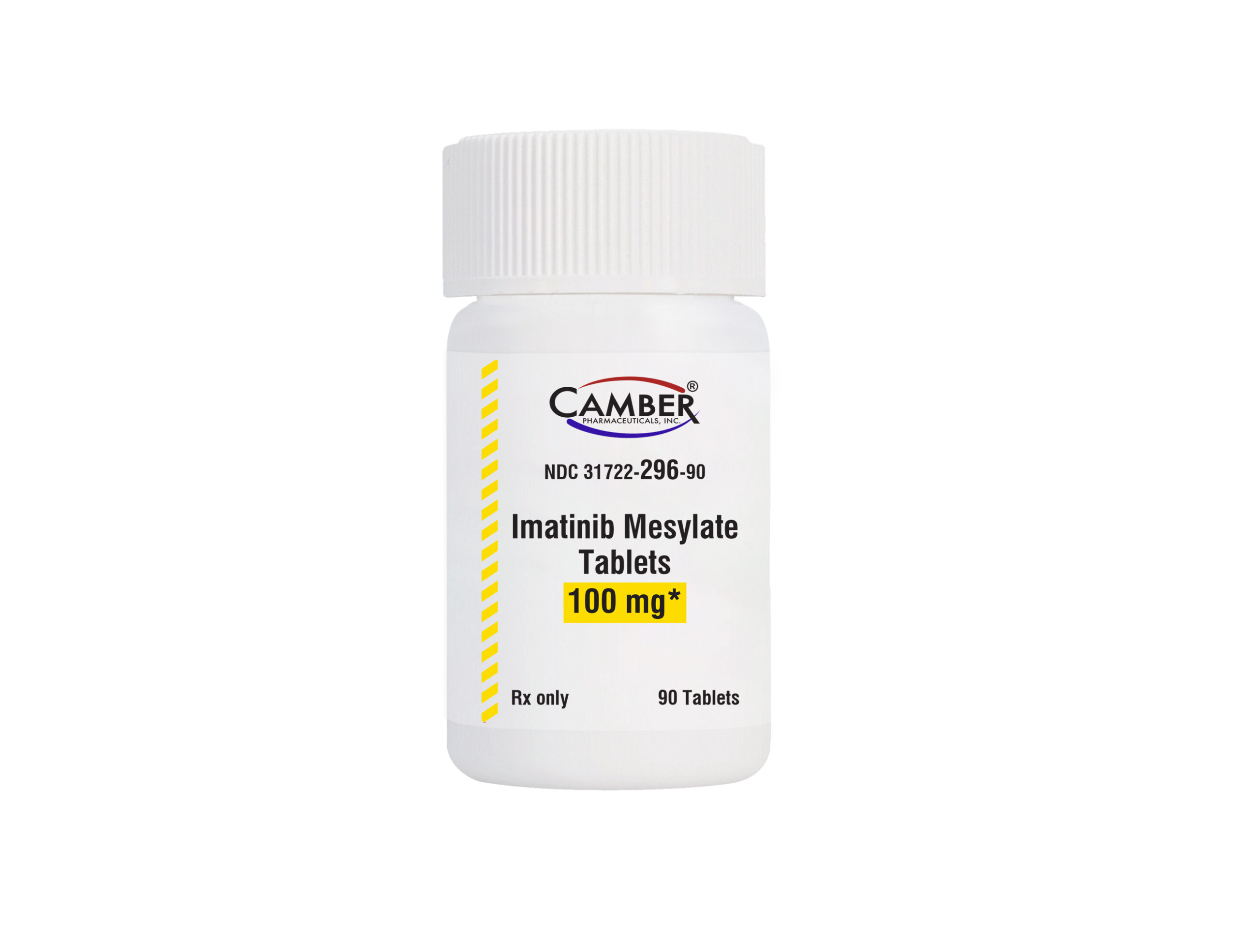
Imatinib Mesylate
Imatinib Mesylate
What is Imatinib Mesylate?
Imatinib Mesylate, marketed under the name Gleevec among others, is a targeted therapy primarily used in the treatment of chronic myeloid leukemia (CML) and gastrointestinal stromal tumors (GISTs). It functions as a tyrosine kinase inhibitor, specifically blocking the BCR-ABL tyrosine kinase, which plays a critical role in the proliferation and survival of cancer cells. This medication effectively manages disease progression, but requires careful monitoring for potential side effects such as edema, nausea, and cytopenias.
Side Effects
- Allergic reaction: Itching or hives, swelling in your face or hands, swelling or tingling in your mouth or throat, chest tightness, trouble breathing
- Blistering, peeling, red skin rash
- Dark urine or pale stools, nausea, vomiting, loss of appetite, yellow skin or eyes
Warnings
- This medicine may make you dizzy or drowsy or cause blurry vision. Do not drive or do anything that could be dangerous until you know how this medicine affects you.
- Keep all medicine out of the reach of children. Never share your medicine with anyone.
- Oral routeMedicines used to treat cancer are very strong and can have many side effects. Before receiving this medicine, make sure you understand all the risks and benefits. It is important for you to work closely with your doctor during your treatment.
- Oral routeIt is not safe to take this medicine during pregnancy. It could harm an unborn baby. Tell your doctor right away if you become pregnant. Use effective birth control during treatment and for 14 days after your treatment ends.
- Tell your doctor if you have kidney disease, liver disease, or heart disease. Tell your doctor if you have had your thyroid removed.
Prescription savings · · · ·
What is Imatinib Mesylate ?
Imatinib Mesylate, marketed under the name Gleevec among others, is a targeted therapy primarily used in the treatment of chronic myeloid leukemia (CML) and gastrointestinal stromal tumors (GISTs). It functions as a tyrosine kinase inhibitor, specifically blocking the BCR-ABL tyrosine kinase, which plays a critical role in the proliferation and survival of cancer cells. This medication effectively manages disease progression, but requires careful monitoring for potential side effects such as edema, nausea, and cytopenias.
- Allergic reaction: Itching or hives, swelling in your face or hands, swelling or tingling in your mouth or throat, chest tightness, trouble breathing
- Blistering, peeling, red skin rash
- Dark urine or pale stools, nausea, vomiting, loss of appetite, yellow skin or eyes
- Decrease in how much or how often you urinate
- Unusual bleeding, bruising, or weakness
- Severe stomach pain, vomiting blood, or bloody or black, tarry stools
- Rapid weight, swelling in your hands, ankles, or feet, trouble breathing, tiredness
- This medicine may make you dizzy or drowsy or cause blurry vision. Do not drive or do anything that could be dangerous until you know how this medicine affects you.
- Keep all medicine out of the reach of children. Never share your medicine with anyone.
- Oral routeMedicines used to treat cancer are very strong and can have many side effects. Before receiving this medicine, make sure you understand all the risks and benefits. It is important for you to work closely with your doctor during your treatment.
- Oral routeIt is not safe to take this medicine during pregnancy. It could harm an unborn baby. Tell your doctor right away if you become pregnant. Use effective birth control during treatment and for 14 days after your treatment ends.
- Tell your doctor if you have kidney disease, liver disease, or heart disease. Tell your doctor if you have had your thyroid removed.
- Do not breastfeed during treatment and for 1 month after your last dose.
- This medicine can cause the following problems:Heart problemsLiver problemsBleeding in your digestive system, which could be seriousTumor lysis syndromeSlow growth in children
- Your doctor will do lab tests at regular visits to check on the effects of this medicine. Keep all appointments.
- This medicine may make you bleed, bruise, or get infections more easily. Take precautions to prevent illness and injury. Wash your hands often.
Imatinib Mesylate Coupons & Prices
Imatinib Mesylate

4 ED medications in one dose
Apomorphine, sildenafil, tadalafil & vardenafil · One sublingual dose · Free express shipping
Imatinib Mesylate prices by dosage
Lowest cash price with a free Rx.com coupon vs. the average retail price.
| Dosage | Quantity | Retail price | Rx.com price |
|---|---|---|---|
| 100mg · Tablet | 30 | $5,314.29 | $31.23 |
| 400mg · Tablet | 30 | $4,154.79 | $85.28 |
Cash prices near ZIP 77433; updated regularly. Actual pharmacy price may vary.
Looking for an imatinib mesylate coupon? Imatinib mesylate is the generic form of Gleevec, a targeted oral cancer therapy used for Philadelphia chromosome-positive chronic myeloid leukemia (Ph+ CML), certain gastrointestinal stromal tumors (GIST), and several other conditions. Multiple FDA-approved generic versions are marketed in the US by manufacturers including Teva, Sun, Apotex, and Hikma, and the cash price you are quoted can differ a great deal from one pharmacy to the next, even within the same town. Rx.com compares prices across more than 60,000 pharmacies so you can see what your prescription actually costs near you. Enter your ZIP code above to see today's price and print, text, or show your free coupon at the pharmacy counter.
What is imatinib mesylate and how does it work?
Imatinib mesylate is a tyrosine kinase inhibitor, an oral targeted therapy that blocks specific signaling proteins (BCR-ABL, KIT, and PDGFR) that certain cancer cells depend on to grow and multiply. Because it works on defined molecular targets rather than dividing cells generally, it is taken as a tablet at home rather than infused, though it is still a serious antineoplastic medicine prescribed and monitored by a specialist.
Per the Gleevec label, FDA-approved uses of the oral tablets include newly diagnosed Ph+ chronic myeloid leukemia in chronic phase in adults and children; Ph+ CML in blast crisis, accelerated phase, or chronic phase after interferon-alpha failure; Ph+ acute lymphoblastic leukemia (relapsed or refractory in adults, and newly diagnosed in children in combination with chemotherapy); myelodysplastic/myeloproliferative diseases with PDGFR gene rearrangements in adults; aggressive systemic mastocytosis in adults without the D816V c-Kit mutation or with unknown mutation status; hypereosinophilic syndrome and/or chronic eosinophilic leukemia in adults, both in those who have the FIP1L1-PDGFR-alpha fusion kinase and in those who are FIP1L1-PDGFR-alpha negative or whose status is unknown (the label sets a different starting dose depending on which applies); dermatofibrosarcoma protuberans in adults that is unresectable, recurrent, or metastatic; Kit (CD117)-positive unresectable and/or metastatic GIST; and adjuvant treatment after resection of Kit (CD117)-positive GIST. Imatinib is not a controlled substance.
What imatinib mesylate costs without insurance
Cash prices for generic imatinib mesylate are not uniform. Different pharmacies buy from different generic manufacturers and set their own cash prices, so the same prescription for the same strength and quantity can be quoted very differently at a chain, a grocery pharmacy, and an independent down the street. That variation is the single biggest reason to compare before you fill, rather than defaulting to whichever pharmacy your prescription was sent to. Enter your ZIP above to see today's price at pharmacies near you.
If you have no insurance, the honest starting point is knowing which help you can actually qualify for. Manufacturer copay programs are not it: the Teva copay card for its imatinib mesylate tablets is for commercially insured patients only and states it is not available to non-insured or cash-paying patients, and the Novartis Oncology Universal Co-pay Program for brand Gleevec is only available to patients with private insurance. Both also exclude Medicare, Medicaid, and other government coverage. The same is true of most independent foundation copay funds (LLS, PAN, HealthWell, Good Days), which generally require you to have insurance and a copay for them to cover.
The avenue built for uninsured patients is the Novartis Patient Assistance Foundation, which provides brand Gleevec at no cost to eligible patients who have no or limited prescription drug coverage and meet income and residency criteria. Your oncologist's office or a hospital or cancer-center financial counselor can help you apply, and those counselors are worth asking about regardless, since they know what is available locally. An Rx.com coupon is a cash-price discount you can use with no insurance at all; if you do have coverage, note that a coupon cannot be combined with insurance, so compare it against your copay and choose the better number. Use whichever path is genuinely cheapest for you, including the ones we earn nothing from.
Imatinib mesylate vs. Gleevec and other kinase inhibitors
Imatinib mesylate is the same active ingredient as Gleevec, the Novartis brand. FDA-approved generic imatinib mesylate tablets are marketed by several manufacturers; whether your pharmacist can swap the generic for a brand prescription depends on your state's substitution law and the generic's FDA therapeutic-equivalence rating, so ask the pharmacist rather than assuming. An imatinib oral solution (Imkeldi, from Shorla Oncology) is also marketed for people who cannot swallow tablets, but it is a separately approved brand product rather than a generic, and it is priced well above generic tablets, so do not expect generic-tablet pricing from it. Whether the generic or a brand costs you less depends on your pharmacy and your coverage, so compare rather than assuming.
Imatinib is not the only BCR-ABL inhibitor. For Ph+ CML, oncologists also use dasatinib (brand Sprycel), nilotinib (brand Tasigna), and bosutinib. For GIST that no longer responds to imatinib, sunitinib is one option. These are not interchangeable; they differ in approved uses, dosing, side effects, and how they behave against specific mutations. Only your oncologist can decide which one fits your disease, and price should never be the reason to switch on your own.
Safety, side effects, and what to avoid
Gleevec's current FDA label carries no boxed warning, but it does list serious risks. Imatinib can cause fetal harm; it was teratogenic in animals at roughly the human 800 mg/day dose adjusted for body surface area. Effective contraception is required during treatment and for at least 14 days after the last dose, and breastfeeding should be avoided during treatment and for 1 month after. Other labeled risks include fluid retention and swelling (around the eyes and in the limbs, and occasionally severe fluid around the lungs or heart, pulmonary edema, ascites, or rapid weight gain, more common in older patients and at higher doses); low blood counts, which is why regular CBC monitoring is standard; liver injury, including rare liver failure, with added risk alongside acetaminophen or chemotherapy; congestive heart failure and left ventricular dysfunction; cardiogenic shock or LV dysfunction at the start of treatment in people with hypereosinophilic syndrome and a high eosinophil burden; tumor lysis syndrome (dehydration and high uric acid should be corrected first); severe skin reactions including Stevens-Johnson syndrome, DRESS, and erythema multiforme; bullous skin reactions; GI irritation and rare GI perforation; bleeding, including tumor-site bleeding in GIST; hypothyroidism in people who have had a thyroidectomy and take levothyroxine; growth retardation in children; and a decline in kidney function with long-term use. Common side effects are nausea, vomiting, diarrhea, muscle cramps, musculoskeletal pain, rash, tiredness, headache, abdominal pain, and puffiness around the eyes.
Interactions matter here. Imatinib is both a CYP3A4 substrate and inhibitor: avoid grapefruit and St. John's wort, and tell your care team about strong CYP3A4 inhibitors or inducers, warfarin (low-molecular-weight heparin is used instead), simvastatin, and any other prescriptions or supplements you take. Report new swelling, sudden weight gain, shortness of breath, unusual bruising or bleeding, yellowing of the skin or eyes, or a spreading or blistering rash to your provider promptly. This page is information, not medical advice; talk with your oncologist or pharmacist about your own situation.
This Imatinib Mesylate information was written and reviewed against authoritative U.S. medical sources — MedlinePlus (U.S. National Library of Medicine), DailyMed, and FDA prescribing information — and checked for accuracy. It is provided for education and is not a substitute for professional medical advice.
Verify the official label: Imatinib Mesylate on DailyMed (FDA)
Reviewed against FDA labeling · Last reviewed July 2026
Related Drugs
Browse more medications: starting with I · full A-Z directory · by condition · common drugs
Medical disclaimer: This information is provided for general educational purposes only and is not medical advice. It is not a substitute for professional diagnosis or treatment. Always consult a licensed physician, pharmacist, or other qualified healthcare provider before starting, stopping, or changing any medication or treatment. Never disregard professional medical advice or delay seeking it because of something you read here. If you think you may have a medical emergency, call your doctor or 911 immediately.


