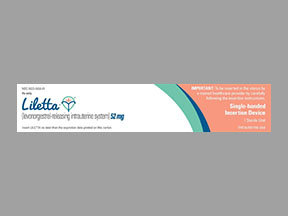
Liletta (52 Mg)
Liletta (52 MG) 1 Intrauterine Device
What is Liletta (52 Mg)?
Liletta (52 mg) is an intrauterine device (IUD) that releases the hormone levonorgestrel, primarily used for long-term birth control and heavy menstrual bleeding management. Once placed inside the uterus by a healthcare professional, it can prevent pregnancy for up to 7 years by thickening cervical mucus and inhibiting sperm penetration. Liletta is both reversible and effective immediately upon insertion, offering a reliable option without the daily maintenance of oral contraceptives.Side Effects
- Unusual bleeding, bruising, or weakness
- Vaginal discharge that has a bad smell, fever, chills, sores on your genitals
- Severe headache, vision changes
Warnings
- If you have the Skyla® or Kyleena®, tell your doctor before you have an MRI test.
- Your doctor will check your progress and the effects of this medicine at regular visits. Keep all appointments.
- This IUD will not protect you from HIV/AIDS or other sexually transmitted diseases.
- Tell your doctor if you have had any problems, infections, or other conditions that affected your reproductive system. There are many problems that could make an IUD a bad choice for you, including if you have fibroids, unexplained bleeding, a uterus that has an unusual shape, a recent infection, a history of pelvic inflammatory disease, an abnormal Pap test, ectopic pregnancy, cancer or suspected cancer, or an existing IUD.
- Tell your doctor if you are breastfeeding, or if you had a baby, miscarriage, or abortion in the past 3 months. Tell your doctor if you have liver disease (including tumor or cancer), heart disease, breast cancer, heart or blood circulation problems (including a slow heartbeat), migraine, high blood pressure, seizures, or a history of fainting, heart valve problems, blood clotting problems, stroke, or heart attack. Tell your doctor if you have problems with your immune system or have had surgery on your female organs (especially fallopian tubes).
Prescription savings · · · ·
What is Liletta (52 Mg) ?
Liletta (52 mg) is an intrauterine device (IUD) that releases the hormone levonorgestrel, primarily used for long-term birth control and heavy menstrual bleeding management. Once placed inside the uterus by a healthcare professional, it can prevent pregnancy for up to 7 years by thickening cervical mucus and inhibiting sperm penetration. Liletta is both reversible and effective immediately upon insertion, offering a reliable option without the daily maintenance of oral contraceptives.- Unusual bleeding, bruising, or weakness
- Vaginal discharge that has a bad smell, fever, chills, sores on your genitals
- Severe headache, vision changes
- Yellow skin or eyes
- Allergic reaction: Itching or hives, swelling in your face or hands, swelling or tingling in your mouth or throat, chest tightness, trouble breathing
- Bloating, stomach or pelvic pain, spasm, tenderness, or cramping that is sudden or severe
- Chest pain, problems with speech or walking, numbness or weakness in your arm or leg or on one side of your body
- Heavy bleeding from your vagina
- Pain during sex, or if your partner feels the hard plastic of the IUD during sex
- If you have the Skyla® or Kyleena®, tell your doctor before you have an MRI test.
- Your doctor will check your progress and the effects of this medicine at regular visits. Keep all appointments.
- This IUD will not protect you from HIV/AIDS or other sexually transmitted diseases.
- Tell your doctor if you have had any problems, infections, or other conditions that affected your reproductive system. There are many problems that could make an IUD a bad choice for you, including if you have fibroids, unexplained bleeding, a uterus that has an unusual shape, a recent infection, a history of pelvic inflammatory disease, an abnormal Pap test, ectopic pregnancy, cancer or suspected cancer, or an existing IUD.
- Tell your doctor if you are breastfeeding, or if you had a baby, miscarriage, or abortion in the past 3 months. Tell your doctor if you have liver disease (including tumor or cancer), heart disease, breast cancer, heart or blood circulation problems (including a slow heartbeat), migraine, high blood pressure, seizures, or a history of fainting, heart valve problems, blood clotting problems, stroke, or heart attack. Tell your doctor if you have problems with your immune system or have had surgery on your female organs (especially fallopian tubes).
- There is a small chance that you could get pregnant when using an IUD, just as there is with any birth control. If you get pregnant, your doctor may remove your IUD to lower the risk of miscarriage or other problems.
- This medicine may cause the following problems:Increased risk of ectopic pregnancy (pregnancy outside the uterus)Increased risk of serious infections, including sepsisIncreased risk of pelvic inflammatory disease (PID) or endometritisPerforation (hole in the wall of your uterus), which can damage other organsIncreased risk for ovarian cystsIncreased risk of cancer of the breast, uterus, or cervixIncreased risk of high blood pressure, stroke, heart attack, or clotting problemsJaundice (yellow skin or eyes)
- You might have some spotting and cramping during the first weeks after the IUD has been inserted. These symptoms should decrease or go away within a few weeks up to 6 months.
- You could have less bleeding or even stop having periods by the end of the first year. Call your doctor if you have a change from your regular bleeding pattern after you have had your IUD for awhile, including more bleeding or if you miss a period (and you were having periods even with your IUD).
- An IUD can slip partly or all the way out of your uterus. If this happens, use condoms or another form of birth control, and call your doctor right away.
Liletta (52 Mg) Coupons & Prices
Liletta (52 MG) 1 Intrauterine Device
4 ED medications in one dose
Apomorphine, sildenafil, tadalafil & vardenafil · One sublingual dose · Free express shipping
Looking for a Liletta 52 mg coupon? Liletta is a hormonal intrauterine device (IUD) that releases levonorgestrel to prevent pregnancy for up to 8 years, and it is also FDA-approved to treat heavy menstrual bleeding for up to 5 years. Because it is placed by a healthcare provider in the office, your out-of-pocket cost can vary a great deal depending on insurance and where the device is supplied. Enter your ZIP above to see today's price at pharmacies near you, and compare it against your insurance and the manufacturer's savings program before you fill.
What is Liletta 52 mg and how does it work?
Liletta is a levonorgestrel-releasing intrauterine system (a hormonal IUD) that contains 52 mg of levonorgestrel, a progestin hormone. Once placed inside the uterus by a trained healthcare provider, it slowly releases the hormone locally to prevent pregnancy. It is FDA-approved as long-acting reversible contraception for up to 8 years, and it is also FDA-approved to treat heavy menstrual bleeding (menorrhagia) for up to 5 years in women who choose to use an IUD for birth control.
The 52 mg dose is the same levonorgestrel dose used in Mirena. Because it is a hormonal IUD, many people notice changes in their bleeding pattern over time, ranging from irregular spotting to lighter or absent periods. Liletta is a prescription device placed in a clinical setting, so any decision about whether it is right for you should be made with your healthcare provider.
Liletta cost, manufacturer savings card, and the Rx.com cash coupon
There is no generic version of Liletta. The maker of Liletta offers an official patient savings program (described on the manufacturer's Liletta website), which is generally intended for people with commercial (private) insurance; eligibility and terms vary, and it typically cannot be used if you have government coverage such as Medicare or Medicaid. If you are uninsured, on Medicare, or the manufacturer card is declined at checkout, an Rx.com cash coupon can be used instead to help lower the cost where the device is dispensed at a pharmacy.
Because Liletta is placed during an office visit, part of your cost may run through your medical benefit rather than a pharmacy, so it is worth checking both. To compare, enter your ZIP above to see today's cash price at nearby pharmacies, then weigh that against your insurance quote and the manufacturer's savings program. Manufacturers sometimes also offer patient-assistance help for those who qualify, so ask your provider's office what options apply to you.
Liletta compared with other IUDs and alternatives
Liletta is one of several intrauterine devices, and the right choice depends on how long you want protection, whether you want a hormonal or hormone-free option, and how you want your periods to change. Hormonal IUDs use levonorgestrel; the copper IUD uses no hormones.
- Mirena — hormonal IUD with the same 52 mg levonorgestrel dose, also approved for heavy menstrual bleeding.
- Kyleena — a lower-dose hormonal IUD.
- Skyla — the lowest-dose, smallest hormonal IUD, often used for a shorter duration.
- Paragard — a hormone-free copper IUD for people who prefer no hormones.
- Levonorgestrel — the progestin hormone found in Liletta and the other hormonal IUDs.
Your provider can help you decide which device best fits your goals and health history.
Safety and important warnings
Liletta does not carry a boxed warning, but there are important risks to understand. If a pregnancy does occur while the device is in place, it is more likely to be ectopic (outside the uterus), and an intrauterine pregnancy can lead to serious complications. Serious infections have occurred, including pelvic inflammatory disease, endometritis, and, rarely, Group A streptococcal sepsis. The device can perforate or embed in the uterus (a higher risk when breastfeeding or postpartum, or with a fixed or tilted uterus), and it can be expelled, which may leave you without contraceptive protection. Ovarian cysts and changes in bleeding, including irregular bleeding or no periods at all, are common.
Liletta should not be used during pregnancy, with a known or suspected uterine or cervical cancer, a distorted uterine cavity, current pelvic infection or high infection risk, a recent postpartum or post-abortion infection, known or suspected breast cancer or other progestin-sensitive cancer, unexplained uterine bleeding, an untreated acute cervical or vaginal infection, or acute liver disease or a liver tumor. This is general information, not medical advice. Talk with your healthcare provider about whether Liletta is safe and appropriate for you, and report severe pain, fever, or unusual bleeding right away.
This Liletta (52 Mg) information was written and reviewed against authoritative U.S. medical sources — MedlinePlus (U.S. National Library of Medicine), DailyMed, and FDA prescribing information — and checked for accuracy. It is provided for education and is not a substitute for professional medical advice.
Verify the official label: Liletta (52 Mg) on DailyMed (FDA)
Reviewed against FDA labeling · Last reviewed July 2026
Related Drugs
Browse more medications: starting with L · full A-Z directory · by condition · common drugs
Medical disclaimer: This information is provided for general educational purposes only and is not medical advice. It is not a substitute for professional diagnosis or treatment. Always consult a licensed physician, pharmacist, or other qualified healthcare provider before starting, stopping, or changing any medication or treatment. Never disregard professional medical advice or delay seeking it because of something you read here. If you think you may have a medical emergency, call your doctor or 911 immediately.


