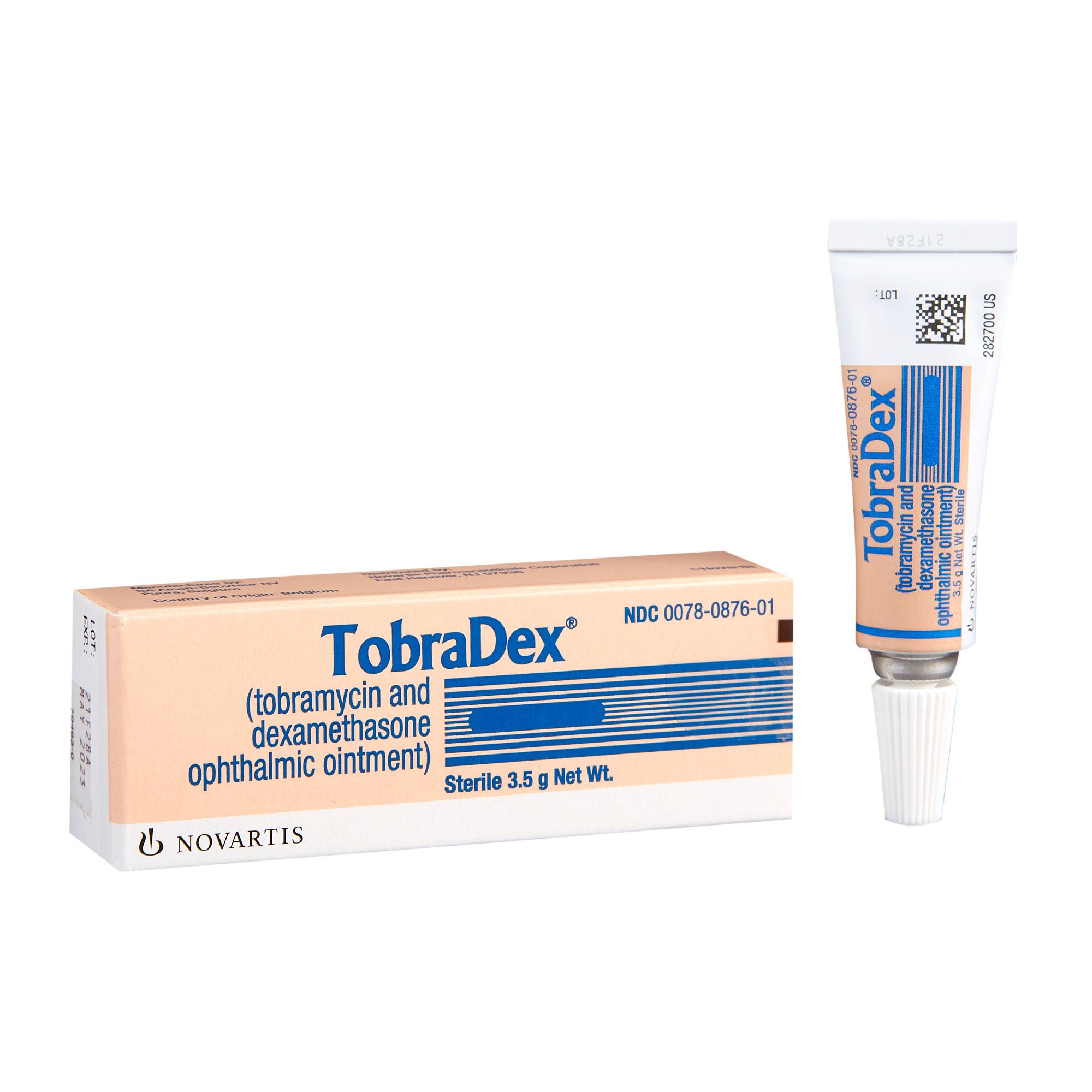
Tobradex
TobraDex
What is Tobradex?
Tobradex is a prescription ophthalmic medication that combines two active ingredients: tobramycin, an antibiotic, and dexamethasone, a corticosteroid. This dual-action formulation effectively treats bacterial eye infections while simultaneously reducing inflammation and associated symptoms like redness and swelling. Tobradex is commonly prescribed for conditions such as conjunctivitis and blepharitis, and is available as eye drops or ointment.
Side Effects
- Allergic reaction: Itching or hives, swelling in your face or hands, swelling or tingling in your mouth or throat, chest tightness, trouble breathing
- Severe eye irritation that was not there before using this medicine
- Vision changes
Warnings
- Call your doctor if your symptoms do not improve or if they get worse.
- Make sure your doctor knows if you have glaucoma, cataracts, or any other eye condition before taking this medicine.
- If you are pregnant or breastfeeding, talk to your doctor before using this medicine.
- Do not stop using this medicine suddenly. Your doctor will need to slowly decrease your dose before you stop it completely.
Prescription savings · · · ·
What is Tobradex ?
Tobradex is a prescription ophthalmic medication that combines two active ingredients: tobramycin, an antibiotic, and dexamethasone, a corticosteroid. This dual-action formulation effectively treats bacterial eye infections while simultaneously reducing inflammation and associated symptoms like redness and swelling. Tobradex is commonly prescribed for conditions such as conjunctivitis and blepharitis, and is available as eye drops or ointment.
- Allergic reaction: Itching or hives, swelling in your face or hands, swelling or tingling in your mouth or throat, chest tightness, trouble breathing
- Severe eye irritation that was not there before using this medicine
- Vision changes
- Call your doctor if your symptoms do not improve or if they get worse.
- Make sure your doctor knows if you have glaucoma, cataracts, or any other eye condition before taking this medicine.
- If you are pregnant or breastfeeding, talk to your doctor before using this medicine.
- Do not stop using this medicine suddenly. Your doctor will need to slowly decrease your dose before you stop it completely.
Tobradex Coupons & Prices
TobraDex
4 ED medications in one dose
Apomorphine, sildenafil, tadalafil & vardenafil · One sublingual dose · Free express shipping
Tobradex prices by dosage
Lowest cash price with a free Rx.com coupon vs. the average retail price.
| Dosage | Quantity | Retail price | Rx.com price |
|---|---|---|---|
| 3.5gm of 0.3-0.1% · Tube | 3.5 | $388.99 | $299.01 |
Cash prices near ZIP 77433; updated regularly. Actual pharmacy price may vary.
Looking for a TobraDex coupon? TobraDex (tobramycin and dexamethasone ophthalmic) is a combination antibiotic-plus-steroid eye medicine, and the good news for your wallet is that an FDA-approved generic of the 0.3%/0.1% suspension (the eye drops) is available in the United States. Rx.com's free cash-price coupon works at most major pharmacies whether you have insurance or not, and you can use it on the brand or ask your pharmacist about the generic. Prices for both the brand and the generic vary a lot from pharmacy to pharmacy, so it pays to compare. Enter your ZIP code above to see today's price near you.
What is TobraDex and how does it work?
TobraDex pairs two medicines in one eye product. Tobramycin is an aminoglycoside antibiotic that treats or helps prevent a surface bacterial infection of the eye. Dexamethasone is a corticosteroid that calms swelling, redness, and irritation. Together they are FDA-approved for steroid-responsive inflammatory conditions of the eye where a corticosteroid is indicated and a surface bacterial infection, or the risk of one, is present. That includes inflammation of the conjunctiva (the lining of the eyelid and the white of the eye), the cornea, and the front part of the eye; chronic anterior uveitis; and corneal injury from chemical, radiation, or thermal burns, or from a foreign body.
TobraDex comes as an ophthalmic suspension (eye drops) with 0.3% tobramycin and 0.1% dexamethasone, and as an ophthalmic ointment. TobraDex ST is a separate suspension with 0.3% tobramycin and a lower 0.05% dexamethasone. For the suspension, the label directs one or two drops into the affected eye every 4 to 6 hours; during the first 24 to 48 hours your prescriber may increase that to one or two drops every 2 hours, then taper as the eye improves. For the ointment, the label directs about a half-inch ribbon into the affected eye 3 to 4 times a day. Shake the suspension before each use, and never let the dropper or ointment tip touch your eye or any surface. Follow the directions your prescriber and the label give you, and do not change the dose on your own.
TobraDex cost: manufacturer savings card vs. the Rx.com cash coupon
The manufacturer of TobraDex ST (the brand is now marketed by Harrow) runs an official savings program on its own website, tobradexst.com. Its current terms cover people with commercial (employer or marketplace) insurance and also allow the pharmacy to run the card for cash-paying patients whose prescription is not covered by commercial insurance, but the card excludes anyone whose prescription is paid in whole or in part by Medicare, Medicaid, TRICARE, VA, or another state or federally funded program. It also cannot be stacked with another discount or cash card on the same fill. Ownership, eligibility rules, expiration dates, and how much a card takes off all change over time, so read the manufacturer's own current terms before you count on one, and note that the program is for the ST product, not for every TobraDex form. If you have Medicare or other government coverage, or the card is declined at the counter, a manufacturer card will not help you.
That is where a cash coupon fits. The free Rx.com coupon is a cash-discount price, not insurance, so it is available to anyone, including Medicare members, and it does not depend on your plan approving anything. You cannot combine it with insurance on the same fill, but you can compare: run the coupon price against your copay, and against the manufacturer program if you qualify for it, and pay whichever is lower. It is also worth asking your prescriber and pharmacist whether the generic tobramycin/dexamethasone 0.3%/0.1% suspension is right for you. What you pay for the brand or the generic depends on the pharmacy you walk into, so check a few before you fill. Enter your ZIP above to see today's price at pharmacies near you.
Generic tobramycin/dexamethasone and other options
Generic tobramycin and dexamethasone ophthalmic suspension, which matches the 0.3%/0.1% TobraDex suspension, is approved and marketed in the U.S., so many people can fill this prescription without paying for the brand. Two caveats: TobraDex ST, the 0.3%/0.05% suspension, has no FDA-approved generic, and pharmacy supply of the generic ointment is inconsistent, so your pharmacist may only be able to get the brand ointment. If you want to compare related eye medicines with your prescriber, these are the ones most often discussed:
- Tobramycin eye drops alone, when an antibiotic is needed but a steroid is not.
- Dexamethasone ophthalmic, or prednisolone acetate, when only a steroid is needed.
- Zylet, another antibiotic-steroid combination that pairs tobramycin with loteprednol.
- Maxitrol, a different antibiotic-steroid combination that pairs neomycin and polymyxin B with dexamethasone.
These are not interchangeable. Which one is appropriate depends on what is wrong with your eye, and only your eye doctor can make that call. Prices differ a lot between them and between pharmacies, so it is worth checking each with the coupon tool above before you fill.
Safety, side effects, and who should not use TobraDex
TobraDex has no boxed warning, but the steroid in it deserves respect. Prolonged corticosteroid use in the eye can raise intraocular pressure and lead to glaucoma with optic-nerve damage and loss of vision; if you use it for 10 days or more, your eye pressure should be monitored, and pressure should be checked routinely in children and in anyone with a history of glaucoma. Long use can also cause posterior subcapsular cataracts, slow healing, and increase the risk of a secondary infection, including fungal infection or reactivation of latent herpes simplex keratitis. Prolonged steroid use in an eye with a thinned cornea or sclera has been linked to perforation. Steroids can also mask or worsen an infection that is already there, which is why follow-up matters.
TobraDex is contraindicated in most viral corneal and conjunctival diseases (including epithelial herpes simplex/dendritic keratitis, vaccinia, and varicella), in mycobacterial eye infection, in fungal eye disease, and in anyone hypersensitive to tobramycin, dexamethasone, or other aminoglycosides. Common side effects include eye irritation, stinging or burning, itching, redness, swollen or crusted eyelids, and blurred vision; a localized allergic reaction to tobramycin can happen. Do not wear contact lenses during treatment with any form of TobraDex; the eye-drop suspensions (including TobraDex ST) are preserved with benzalkonium chloride, which soft lenses can absorb, and the ointment is preserved with chlorobutanol. It is for use in the eye only and is never injected into the eye. This page is general information, not medical advice. Talk with your eye doctor or pharmacist about your own situation, and call them if your eye gets worse or does not improve.
This Tobradex information was written and reviewed against authoritative U.S. medical sources — MedlinePlus (U.S. National Library of Medicine), DailyMed, and FDA prescribing information — and checked for accuracy. It is provided for education and is not a substitute for professional medical advice.
Verify the official label: Tobradex on DailyMed (FDA)
Reviewed against FDA labeling · Last reviewed July 2026
Related Drugs
Browse more medications: starting with T · full A-Z directory · by condition · common drugs
Medical disclaimer: This information is provided for general educational purposes only and is not medical advice. It is not a substitute for professional diagnosis or treatment. Always consult a licensed physician, pharmacist, or other qualified healthcare provider before starting, stopping, or changing any medication or treatment. Never disregard professional medical advice or delay seeking it because of something you read here. If you think you may have a medical emergency, call your doctor or 911 immediately.


