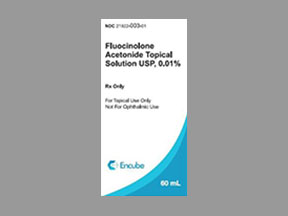
Fluocinolone Acetonide
Fluocinolone Acetonide 20ML of 0.01%
¿Qué es Fluocinolone Acetonide?
El acetónido de fluocinolona es un corticosteroide sintético potente utilizado principalmente para reducir la inflamación en varios trastornos de la piel, como el eccema y la psoriasis. Está disponible en varias formas, incluyendo cremas, ungüentos y aceites, proporcionando alivio dirigido mediante la reducción de la hinchazón, rojez y picazón. Este medicamento funciona activando sustancias naturales en la piel para suprimir las respuestas inmunitarias y la inflamación.Side Effects
- Red or swollen skin.
- Pus or blisters on the skin.
- Acne.
Warnings
- If you are pregnant or breastfeeding, talk to your doctor before using this medicine.
- You should not use this medicine for a longer period of time than your doctor ordered.
- Before using this medicine, let your doctor know if you have diabetes, a stomach ulcer, or tuberculosis (TB).
- Call your doctor if your symptoms get worse, or do not clear up after 7 days of treatment.
- You may be more likely to have side effects from this medicine if you are over 60 years of age.
Prescription savings · ·
¿Qué es Fluocinolone Acetonide ?
El acetónido de fluocinolona es un corticosteroide sintético potente utilizado principalmente para reducir la inflamación en varios trastornos de la piel, como el eccema y la psoriasis. Está disponible en varias formas, incluyendo cremas, ungüentos y aceites, proporcionando alivio dirigido mediante la reducción de la hinchazón, rojez y picazón. Este medicamento funciona activando sustancias naturales en la piel para suprimir las respuestas inmunitarias y la inflamación.Fluocinolone Acetonide Cupones y Precios - Rx.com
Fluocinolone Acetonide 20ML of 0.01%

Weight-loss medication, prescribed online
Proveedores con licencia en EE. UU. · No insurance needed · Shipped to your door
Fluocinolone Acetonide prices by dosage
Lowest cash price with a free Rx.com coupon vs. the average retail price.
| Dosis | Cantidad | Retail price | Rx.com price |
|---|---|---|---|
| 0.5gm of · Bottle | 30 | $8,543.99 | $7,107.24 |
| 1gm of · Bottle | 60 | — | $4,833.49 |
| 5gm of · Bottle | 60 | — | $3,746.54 |
| 10gm of · Bottle | 10 | $2,904.49 | $2,372.35 |
| 25gm of · Bottle | 60 | — | $14,209.08 |
| 60ml of 0.01% · Bottle | 60 | $187.50 | $25.05 |
Cash prices near ZIP 77433; updated regularly. Actual pharmacy price may vary.
Un cupón de fluocinolone acetonide de Rx.com puede reducir lo que paga en el mostrador de la farmacia por este corticosteroide de receta común, que se usa para calmar el enrojecimiento, la hinchazón y la picazón de las afecciones de la piel que responden a los esteroides, como el eczema, la psoriasis, la dermatitis seborreica y la dermatitis de contacto. La fluocinolone acetonide es la forma genérica de marcas como Synalar, y los genéricos suelen ser la manera de menor costo de surtirla, pero el precio en efectivo aún varía mucho de una farmacia a otra, y las presentaciones en crema, ungüento, solución, aceite y champú tienen precios diferentes. Ingrese su código postal arriba para comparar el precio de hoy de fluocinolone acetonide en más de 60,000 farmacias e imprima, envíe por mensaje de texto o por correo electrónico su tarjeta de descuento gratuita antes de ir.
¿Qué es la fluocinolone acetonide y cómo funciona?
La fluocinolone acetonide es un corticosteroide fluorado sintético (un glucocorticoide) que se aplica sobre la piel o el cuero cabelludo. Los corticosteroides funcionan calmando la respuesta inflamatoria en la piel, lo que alivia el enrojecimiento, la hinchazón, la descamación y la picazón que acompañan a las afecciones de la piel que responden a los esteroides. Está aprobada por la FDA para el alivio de las manifestaciones inflamatorias y de picazón de las dermatosis que responden a los corticosteroides, lo que en términos cotidianos con mayor frecuencia significa eczema (dermatitis atópica), psoriasis, dermatitis seborreica, dermatitis de contacto y liquen plano.
Viene en varias presentaciones, cada una con su propio uso aprobado:
- Crema, ungüento y solución tópica (0.01% y 0.025%) - para afecciones de la piel que responden a los corticosteroides; se vende como genérico y bajo la marca Synalar.
- Aceite tópico 0.01% (Derma-Smoothe/FS) - un aceite corporal indicado para la dermatitis atópica en adultos y niños, y un aceite para el cuero cabelludo indicado para la psoriasis del cuero cabelludo en adultos.
- Champú 0.01% (Capex) - indicado para la dermatitis seborreica del cuero cabelludo.
- Crema combinada (Tri-Luma) - fluocinolone acetonide 0.01% combinada con hidroquinona y tretinoína, para el melasma del rostro.
Una línea de productos completamente aparte de implantes intravítreos de fluocinolone acetonide es utilizada por los especialistas de los ojos para el edema macular diabético y la uveítis crónica no infecciosa de la parte posterior del ojo. Esos son productos quirúrgicos para los ojos, no los medicamentos tópicos para la piel que la mayoría de las personas busca, y tienen precios y se dispensan de manera muy diferente.
Costo de la fluocinolone acetonide y ahorros con cupón
La fluocinolone acetonide está disponible como genérico aprobado por la FDA, por lo que ya es uno de los esteroides tópicos de receta más asequibles, y la mayoría de las personas que pagan en efectivo obtendrán un mejor precio con el genérico que con una marca como Synalar, Capex o Derma-Smoothe/FS. No hay una tarjeta de ahorro de copago del fabricante para el genérico. Pero "genérico" no significa "un solo precio": el precio en efectivo del mismo tubo o frasco puede diferir considerablemente entre dos farmacias de la misma calle, y también depende de la presentación (la crema y el ungüento suelen ser más baratos que el aceite, el champú o la crema combinada), la concentración y el tamaño del envase que indique su receta.
Esa variación es exactamente la razón por la que comparar importa. Rx.com verifica los precios de la fluocinolone acetonide en más de 60,000 farmacias de EE. UU., incluidas las grandes cadenas, las farmacias de supermercados y almacenes, y las independientes, y luego le muestra el precio en efectivo con descuento en cada una. Ingrese su código postal arriba para ver el precio de hoy cerca de usted, y lleve el cupón gratuito de Rx.com al mostrador. El descuento es para clientes que pagan en efectivo y no se puede combinar con el seguro, así que si usted sí tiene cobertura, vale la pena pedirle al farmacéutico que calcule ambos y le cobre el que sea más bajo. Si su proveedor recetó una presentación específica, pregunte si una presentación diferente o un tubo más grande costaría menos por uso antes de surtirla.
Cómo se compara la fluocinolone acetonide con otros esteroides tópicos
Los corticosteroides tópicos suelen clasificarse según su potencia, y la fluocinolone acetonide se ubica en el rango de baja a media según su concentración (0.01% o 0.025%) y su vehículo (los ungüentos llevan a un esteroide dado hacia el extremo más fuerte, mientras que las soluciones, los aceites y los champús suelen ser más suaves para la piel). Esa posición intermedia es la razón por la que quienes recetan a menudo lo eligen para áreas más grandes o para erupciones de más larga duración, en lugar de recurrir directamente a un esteroide de alta potencia.
Corticosteroides tópicos relacionados que su proveedor podría considerar, aproximadamente de más suave a más fuerte:
- hydrocortisone y desonide - baja potencia, a menudo usados en el rostro o en piel delgada y en niños
- triamcinolone acetonide y mometasone furoate - potencia media, alternativas muy comunes para el eczema y la psoriasis
- fluocinonide y betamethasone dipropionate - mayor potencia, para placas más gruesas o más rebeldes
- clobetasol propionate - entre los más fuertes, reservado para tratamientos cortos en áreas resistentes
Todos estos están disponibles como genéricos, y todos varían de precio según la farmacia, así que si su proveedor le da una opción, vale la pena comparar antes de surtir. Solo su proveedor puede decidir qué potencia es la adecuada para su erupción y para la parte del cuerpo en la que se encuentra.
Seguridad, efectos secundarios y cosas que debe informar a su proveedor
La fluocinolone acetonide tópica no tiene advertencia en recuadro. Los problemas más comunes son locales: ardor, picazón, irritación, resequedad, foliculitis, erupciones parecidas al acné, aclaramiento de la piel, dermatitis alérgica de contacto y, con un uso más prolongado, adelgazamiento de la piel (atrofia), estrías y sarpullido por calor. Puede absorberse suficiente esteroide a través de la piel como para afectar al cuerpo en su conjunto, lo que puede causar supresión reversible del eje hipotálamo-hipófisis-suprarrenal (HPA), síndrome de Cushing, azúcar alta en la sangre y azúcar en la orina. Ese riesgo aumenta con una mayor potencia, al tratar un área grande, al usarlo durante mucho tiempo, al cubrir el área con vendajes oclusivos o al aplicarlo sobre piel lastimada. Los niños absorben proporcionalmente más debido a su relación entre superficie de la piel y peso corporal, por lo que enfrentan un mayor riesgo de supresión del eje HPA y de retraso en el crecimiento.
Úselo exactamente como se le indique: no vende, cubra ni envuelva el área tratada a menos que su proveedor se lo indique, y evite los ojos, el rostro, la ingle y las axilas a menos que su proveedor lo indique específicamente. No lo use sobre una infección de la piel no tratada, e informe a su proveedor si una erupción no está desapareciendo o parece estar empeorando. Las formulaciones en aceite Derma-Smoothe/FS contienen aceite de cacahuate refinado, así que informe a su proveedor si tiene alergia al cacahuate. Las presentaciones de implante intravítreo para los ojos conllevan sus propios riesgos aparte, incluyendo cataratas, aumento de la presión ocular o glaucoma, e infección ocular. Esta página es información general, no consejo médico; hable con su médico o farmacéutico sobre su afección específica, otros medicamentos y cuánto tiempo usar este.
La información sobre Fluocinolone Acetonide fue redactada y revisada con base en fuentes médicas autorizadas de EE. UU. (MedlinePlus, de la Biblioteca Nacional de Medicina de EE. UU.; DailyMed; y la información de prescripción de la FDA) y verificada para asegurar su precisión. Se ofrece con fines educativos y no sustituye el consejo médico profesional.
Consulte la etiqueta oficial: Fluocinolone Acetonide en DailyMed (FDA)
Revisado con base en el etiquetado de la FDA · Última revisión: julio de 2026
Medicamentos Relacionados
Browse more medications: starting with F · full A-Z directory · by condition · common drugs
Medical disclaimer: This information is provided for general educational purposes only and is not medical advice. It is not a substitute for professional diagnosis or treatment. Always consult a licensed physician, pharmacist, or other qualified healthcare provider before starting, stopping, or changing any medication or treatment. Never disregard professional medical advice or delay seeking it because of something you read here. If you think you may have a medical emergency, call your doctor or 911 immediately.


