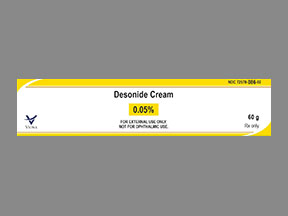
Desonide
Desonide 60GM of 0.05%
¿Qué es Desonide?
Tridesilon se utiliza para tratar infecciones de la piel. Desonide es la versión genérica de Tridesilon. En promedio, Tridesilon tiene un precio de aproximadamente $689 por un suministro de 60 g de crema al 0,05%. Puedes utilizar nuestra tarjeta de ahorros Singlecare gratuita para recibir un descuento de hasta el 80% en Tridesilon en una farmacia local que participe con Singlecare.Side Effects
- Increased hunger, thirst, or urination, weight loss
- Severe itching, burning, or skin irritation
- Allergic reaction: Itching or hives, swelling in your face or hands, swelling or tingling in your mouth or throat, chest tightness, trouble breathing
Warnings
- Your doctor will do lab tests at regular visits to check on the effects of this medicine. Keep all appointments.
- Keep all medicine out of the reach of children. Never share your medicine with anyone.
- If your condition becomes worse or does not improve after 2 to 4 weeks, call your doctor.
- This medicine is not for long-term use.
- Tell your doctor if you are pregnant or breastfeeding, or if you have diabetes, adrenal gland problems, eye or vision problems, or any type of skin infection.
Prescription savings · ·
¿Qué es Desonide ?
Tridesilon se utiliza para tratar infecciones de la piel. Desonide es la versión genérica de Tridesilon. En promedio, Tridesilon tiene un precio de aproximadamente $689 por un suministro de 60 g de crema al 0,05%. Puedes utilizar nuestra tarjeta de ahorros Singlecare gratuita para recibir un descuento de hasta el 80% en Tridesilon en una farmacia local que participe con Singlecare.Desonide Cupones y Precios - Rx.com
Desonide 60GM of 0.05%

Weight-loss medication, prescribed online
Licensed U.S. providers · No insurance needed · Shipped to your door
Desonide prices by dosage
Lowest cash price with a free Rx.com coupon vs. the average retail price.
| Dosis | Cantidad | Retail price | Rx.com price |
|---|---|---|---|
| 15gm of 0.05% · Tube Of Cream | 60 | $323.89 | $29.38 |
| 60gm of 0.05% · Tube Of Cream | 60 | $117.29 | $24.87 |
Cash prices near ZIP 77433; updated regularly. Actual pharmacy price may vary.
Un cupón de desonide de Rx.com puede reducir lo que paga en el mostrador de la farmacia por este esteroide tópico, ya sea que su receta sea para la crema, el ungüento, la loción o el gel. Las presentaciones de desonide en crema, ungüento, loción y gel están todas disponibles como genéricos, pero los precios en efectivo aún varían mucho de una farmacia a otra, incluso entre tiendas de la misma ciudad, así que la farmacia que elija sí importa. Rx.com compara precios en más de 60,000 farmacias en todo el país. Ingrese su código postal arriba para ver el precio de hoy cerca de usted e imprima, envíe por mensaje de texto o muestre el cupón en el mostrador.
¿Qué es desonide y cómo funciona?
Desonide es un corticosteroide tópico. Aplicado sobre la piel, calma la inflamación y la picazón detrás de muchas erupciones. Su etiqueta de la FDA no le asigna una clase de potencia numerada: las etiquetas de la crema de desonide al 0.05% y del ungüento al 0.05% indican que los estudios señalan que están "en el rango bajo de potencia" en comparación con otros corticosteroides tópicos, mientras que la etiqueta de la loción de desonide al 0.05% lo describe como un corticosteroide de potencia baja a media, en el "rango de potencia bajo a medio". En las tablas de potencia estándar que usan muchos médicos, la crema de desonide al 0.05% suele ubicarse en la Clase VI (potencia baja), y el ungüento se ubica en la Clase V en varias de esas mismas tablas, así que la clasificación puede cambiar según el vehículo.
La crema, el ungüento y la loción al 0.05% están aprobados por la FDA para el alivio de las manifestaciones inflamatorias y pruriginosas de las dermatosis que responden a corticosteroides. El gel Desonate al 0.05% está aprobado específicamente para el tratamiento de la dermatitis atópica (eczema) de leve a moderada en pacientes de 3 meses de edad en adelante.
Debido a que se ubica en el extremo más bajo de la escala de potencia de los esteroides, desonide suele ser la opción para la piel delicada, como la cara, los párpados, la ingle y los pliegues de la piel, y para bebés y niños, donde por lo general se evitaría un esteroide más fuerte. En Estados Unidos se ha comercializado bajo nombres de marca que incluyen Desonate (gel), DesOwen (crema, loción, ungüento) y LoKara (loción). Tridesilon fue descontinuado y ya no se comercializa, y la espuma Verdeso (desonide) también fue descontinuada; actualmente no hay ningún producto de desonide en espuma listado en DailyMed. Desonide no es una sustancia controlada.
Costo de desonide sin seguro y cómo ayuda un cupón
Las presentaciones de desonide en crema, ungüento, loción y gel están todas disponibles como genéricos, y los genéricos suelen ser la forma de menor costo de surtir esta receta. Pero "genérico" no significa que todas las farmacias cobren lo mismo. Los precios en efectivo por el mismo tubo o frasco pueden variar bastante entre una cadena, una farmacia de supermercado y una independiente en la misma calle, y por eso exactamente vale la pena el minuto que toma comparar antes de surtir.
Si paga en efectivo o tiene un deducible alto, un cupón de descuento gratuito de Rx.com le da un precio en efectivo en el mostrador sin necesidad de seguro y sin cuota de membresía. Ingrese su código postal arriba para ver el precio de hoy en las farmacias cerca de usted y luego elija la que le convenga más. Los precios también dependen de la presentación que le recetó su profesional, ya que el gel, la crema, el ungüento y la loción tienen precios diferentes y no son intercambiables sin la autorización de quien le receta. No existe un programa de tarjeta de ahorro del fabricante para el desonide genérico; si le recetaron una marca específica, puede consultar el sitio web oficial de ese fabricante, aunque los requisitos y términos varían y muchos programas excluyen a las personas con seguro del gobierno.
Desonide en comparación con otros esteroides tópicos
Los esteroides tópicos se clasifican por potencia, y desonide se ubica en el extremo más bajo de ese rango. La hidrocortisona es la otra opción de potencia baja de uso común y está disponible sin receta en concentraciones más bajas. Las opciones de potencia media que quien le receta podría considerar para piel más gruesa o erupciones más difíciles incluyen la triamcinolona, la fluocinolona, la mometasona y el butirato de hidrocortisona. La alclometasona es otra opción de potencia más baja. Los agentes más fuertes, como la betametasona y el clobetasol, generalmente se reservan para la piel más gruesa o más resistente y por lo general se evitan en la cara y en los pliegues de la piel.
Para el eczema en zonas sensibles, algunos profesionales usan opciones sin esteroides como el ungüento de tacrolimus o la crema de pimecrolimus. Si le recetaron el gel de marca, también puede buscar información sobre Desonate. Cuál producto es el adecuado depende de dónde está la erupción, qué tan gruesa es la piel y su edad, así que esta es una conversación para tener con quien le receta o con su farmacéutico, no un cambio para hacer por su cuenta.
Información de seguridad que debe conocer
Desonide no tiene advertencia en recuadro. Aun así, los esteroides tópicos pueden absorberse a través de la piel, y las etiquetas ponen límites al tiempo que se usan. La crema de desonide al 0.05% y el ungüento al 0.05% no deben usarse por más de dos semanas a menos que lo indique un médico, y no deben usarse con vendajes oclusivos. Para el gel Desonate al 0.05%, la etiqueta indica que el tratamiento no debe exceder 4 semanas consecutivas y que no se ha establecido la seguridad más allá de 4 semanas de uso. Para la loción de desonide al 0.05%, la etiqueta no establece un límite máximo, pero señala que si no se observa mejoría dentro de 2 semanas, puede ser necesario reevaluar el diagnóstico, y que la loción no debe usarse con vendajes oclusivos. Si no se observa mejoría dentro de 4 semanas con Desonate, puede ser necesario reevaluar el diagnóstico. Quien le receta puede indicar un uso más prolongado o diferente, pero estos son los límites de la propia etiqueta.
Con el uso prolongado, el tratamiento de áreas grandes, el uso bajo oclusión o el uso en piel delgada, desonide puede causar supresión reversible del eje HPA, síndrome de Cushing y azúcar alta en la sangre o azúcar en la orina. Los niños absorben proporcionalmente más porque tienen una mayor proporción de superficie de piel respecto a masa corporal, y han presentado crecimiento lineal más lento, aumento de peso retrasado y aumento de la presión dentro del cráneo. No lo aplique bajo pañales ajustados ni calzones de plástico, que actúan como vendajes oclusivos. Las reacciones locales pueden incluir ardor, escozor, picazón, resequedad, foliculitis, adelgazamiento de la piel, estrías, vasos sanguíneos pequeños visibles, pérdida del color de la piel, dermatitis perioral y erupciones parecidas al acné.
Desonide no es para uso en los ojos; evite los ojos, la boca, la nariz y las áreas genital y rectal. Por lo general se evita el uso prolongado en la cara, la ingle o las axilas. Deje de usarlo y llame a quien le receta si aparece irritación o una infección de la piel, ya que también podría necesitarse un antimicrobiano. Esta página es información general, no consejo médico; siga las indicaciones de quien le receta y pregunte a su farmacéutico si algo no le queda claro.
La información sobre Desonide fue redactada y revisada con base en fuentes médicas autorizadas de EE. UU. (MedlinePlus, de la Biblioteca Nacional de Medicina de EE. UU.; DailyMed; y la información de prescripción de la FDA) y verificada para asegurar su precisión. Se ofrece con fines educativos y no sustituye el consejo médico profesional.
Consulte la etiqueta oficial: Desonide en DailyMed (FDA)
Revisado con base en el etiquetado de la FDA · Última revisión: julio de 2026
Medicamentos Relacionados
Browse more medications: starting with D · full A-Z directory · by condition · common drugs
Medical disclaimer: This information is provided for general educational purposes only and is not medical advice. It is not a substitute for professional diagnosis or treatment. Always consult a licensed physician, pharmacist, or other qualified healthcare provider before starting, stopping, or changing any medication or treatment. Never disregard professional medical advice or delay seeking it because of something you read here. If you think you may have a medical emergency, call your doctor or 911 immediately.


