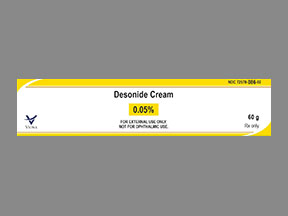
Desonide
Desonide 60GM of 0.05%
What is Desonide?
Tridesilon is used to treat skin infections. Desonide is the generic version of Tridesilon. On average, Tridesilon is priced at approximately $689 for a supply of 60 g, 0.05% cream. You can use our free Singlecare savings card to receive a Tridesilon discount of up to 80% at a local pharmacy that participates with Singlecare.Side Effects
- Increased hunger, thirst, or urination, weight loss
- Severe itching, burning, or skin irritation
- Allergic reaction: Itching or hives, swelling in your face or hands, swelling or tingling in your mouth or throat, chest tightness, trouble breathing
Warnings
- Your doctor will do lab tests at regular visits to check on the effects of this medicine. Keep all appointments.
- Keep all medicine out of the reach of children. Never share your medicine with anyone.
- If your condition becomes worse or does not improve after 2 to 4 weeks, call your doctor.
- This medicine is not for long-term use.
- Tell your doctor if you are pregnant or breastfeeding, or if you have diabetes, adrenal gland problems, eye or vision problems, or any type of skin infection.
Prescription savings · · · ·
What is Desonide ?
Tridesilon is used to treat skin infections. Desonide is the generic version of Tridesilon. On average, Tridesilon is priced at approximately $689 for a supply of 60 g, 0.05% cream. You can use our free Singlecare savings card to receive a Tridesilon discount of up to 80% at a local pharmacy that participates with Singlecare.- Increased hunger, thirst, or urination, weight loss
- Severe itching, burning, or skin irritation
- Allergic reaction: Itching or hives, swelling in your face or hands, swelling or tingling in your mouth or throat, chest tightness, trouble breathing
- Blurred vision or other changes in vision, eye pain
- Color changes on the skin, dark freckles, easy bruising, muscle weakness, round or puffy face
- Your doctor will do lab tests at regular visits to check on the effects of this medicine. Keep all appointments.
- Keep all medicine out of the reach of children. Never share your medicine with anyone.
- If your condition becomes worse or does not improve after 2 to 4 weeks, call your doctor.
- This medicine is not for long-term use.
- Tell your doctor if you are pregnant or breastfeeding, or if you have diabetes, adrenal gland problems, eye or vision problems, or any type of skin infection.
- This medicine may cause the following problems:Adrenal gland problems (including Cushing syndrome)High blood sugar levelsIncreased risk of eye problems (including cataracts or glaucoma)
- Topical application routeDo not use this medicine to treat a skin problem your doctor has not examined.
Desonide Coupons & Prices
Desonide 60GM of 0.05%

Weight-loss medication, prescribed online
Licensed U.S. providers · No insurance needed · Shipped to your door
Desonide prices by dosage
Lowest cash price with a free Rx.com coupon vs. the average retail price.
| Dosage | Quantity | Retail price | Rx.com price |
|---|---|---|---|
| 15gm of 0.05% · Tube Of Cream | 60 | $323.89 | $29.38 |
| 60gm of 0.05% · Tube Of Cream | 60 | $117.29 | $24.87 |
Cash prices near ZIP 77433; updated regularly. Actual pharmacy price may vary.
A desonide coupon from Rx.com can lower what you pay at the pharmacy counter for this topical steroid, whether your prescription is for the cream, ointment, lotion, or gel. Desonide's cream, ointment, lotion, and gel forms are all available as generics, but cash prices still vary widely from one pharmacy to the next, even between stores in the same town, so the pharmacy you choose matters. Rx.com compares prices at more than 60,000 pharmacies nationwide. Enter your ZIP code above to see today's price near you and print, text, or show the coupon at the counter.
What is desonide and how does it work?
Desonide is a topical corticosteroid. Applied to the skin, it calms the inflammation and itching behind many rashes. Its FDA label does not assign a numbered potency class: the labels for desonide cream 0.05% and ointment 0.05% say studies indicate they are "in the low range of potency" compared with other topical corticosteroids, while the desonide lotion 0.05% label describes it as a low to medium potency corticosteroid, in the "low to medium range of potency." On the standard potency charts many clinicians use, desonide cream 0.05% is usually placed in Class VI (low potency), and the ointment is placed in Class V in several of those same charts, so the ranking can shift with the vehicle.
The cream, ointment, and lotion 0.05% are FDA-approved for the relief of the inflammatory and pruritic manifestations of corticosteroid-responsive dermatoses. Desonate gel 0.05% is specifically approved for the treatment of mild to moderate atopic dermatitis (eczema) in patients 3 months of age and older.
Because it sits at the lower end of the steroid potency scale, desonide is often the choice for delicate skin, such as the face, eyelids, groin, and skin folds, and for infants and children, where a stronger steroid would usually be avoided. In the US it has been marketed under brand names including Desonate (gel), DesOwen (cream, lotion, ointment), and LoKara (lotion). Tridesilon has been discontinued and is no longer marketed, and Verdeso (desonide) foam has also been discontinued; there is currently no desonide foam product listed on DailyMed. Desonide is not a controlled substance.
Desonide cost without insurance, and how a coupon helps
Desonide's cream, ointment, lotion, and gel forms are all available as generics, and generics are typically the lower-cost way to fill this prescription. But "generic" does not mean every pharmacy charges the same. Cash prices for the same tube or bottle can differ significantly between a chain, a grocery-store pharmacy, and an independent down the street, which is exactly why comparing before you fill is worth the minute it takes.
If you are paying cash or have a high deductible, a free Rx.com discount coupon gives you a cash price at the counter with no insurance required and no membership fee. Enter your ZIP code above to see today's price at pharmacies near you, then pick the one that works out best. Prices also depend on the form your prescriber wrote for, since gel, cream, ointment, and lotion are priced differently and are not interchangeable without your prescriber's say-so. There is no manufacturer savings card program for generic desonide; if you were prescribed a specific brand, you can check that manufacturer's official website, though eligibility and terms vary and many programs exclude people with government insurance.
Desonide compared with other topical steroids
Topical steroids are ranked by potency, and desonide sits at the lower end of that range. Hydrocortisone is the other commonly used low-potency option and is available over the counter in lower strengths. Mid-potency options your prescriber might consider for thicker skin or tougher rashes include triamcinolone, fluocinolone, mometasone, and hydrocortisone butyrate. Alclometasone is another lower-potency choice. Stronger agents such as betamethasone and clobetasol are generally reserved for thicker or more resistant skin and are usually avoided on the face and skin folds.
For eczema on sensitive areas, some prescribers use non-steroid options such as tacrolimus ointment or pimecrolimus cream. If you were prescribed the branded gel, you can also look up Desonate. Which product is right depends on where the rash is, how thick the skin is, and your age, so this is a conversation for your prescriber or pharmacist, not a swap to make on your own.
Safety information to know
Desonide has no boxed warning. Even so, topical steroids can be absorbed through the skin, and the labels put limits on how long you use them. Desonide cream 0.05% and ointment 0.05% should not be used for longer than two weeks unless directed by a physician, and they should not be used with occlusive dressings. For Desonate gel 0.05%, the label states that treatment should not exceed 4 consecutive weeks, and that safety beyond 4 weeks of use has not been established. For desonide lotion 0.05%, the label does not set an outer limit but says that if no improvement is seen within 2 weeks, reassessment of the diagnosis may be necessary, and the lotion should not be used with occlusive dressings. If no improvement is seen within 4 weeks on Desonate, reassessment of the diagnosis may be necessary. Your prescriber can direct longer or different use, but these are the label's own limits.
With prolonged use, treatment of large areas, use under occlusion, or use on thin skin, desonide can cause reversible suppression of the HPA axis, Cushing's syndrome, and high blood sugar or sugar in the urine. Children absorb proportionally more because they have a larger skin-surface-to-body-mass ratio, and have shown slowed linear growth, delayed weight gain, and increased pressure inside the skull. Do not apply it under tight-fitting diapers or plastic pants, which act like occlusive dressings. Local reactions can include burning, stinging, itching, dryness, folliculitis, thinning of the skin, stretch marks, visible small blood vessels, loss of skin color, perioral dermatitis, and acne-like eruptions.
Desonide is not for use in the eyes; avoid the eyes, mouth, nose, and the genital and rectal areas. Prolonged use on the face, groin, or underarms is generally avoided. Stop and call your prescriber if irritation develops or a skin infection appears, since an antimicrobial may also be needed. This page is general information, not medical advice; follow your prescriber's directions and ask your pharmacist if anything is unclear.
This Desonide information was written and reviewed against authoritative U.S. medical sources — MedlinePlus (U.S. National Library of Medicine), DailyMed, and FDA prescribing information — and checked for accuracy. It is provided for education and is not a substitute for professional medical advice.
Verify the official label: Desonide on DailyMed (FDA)
Reviewed against FDA labeling · Last reviewed July 2026
Related Drugs
Browse more medications: starting with D · full A-Z directory · by condition · common drugs
Medical disclaimer: This information is provided for general educational purposes only and is not medical advice. It is not a substitute for professional diagnosis or treatment. Always consult a licensed physician, pharmacist, or other qualified healthcare provider before starting, stopping, or changing any medication or treatment. Never disregard professional medical advice or delay seeking it because of something you read here. If you think you may have a medical emergency, call your doctor or 911 immediately.


