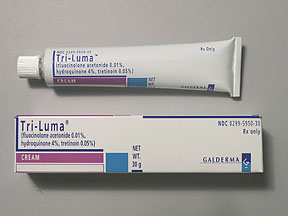
Tri-Luma
Tri-Luma 30GM of 0.01-4-0.05%
What is Tri-Luma?
Tri-Luma is a prescription medication used to treat melasma, a skin condition resulting in dark patches on the face. It combines three active ingredients to help reduce pigmentation and improve skin tone. Common side effects may include irritation or dryness. For easy access, connect with a licensed provider at Rx.com and explore options for mail-order prescriptions, coupons, and savings cards to manage your costs effectively.Side Effects
- Allergic reaction: Itching or hives, swelling in your face or hands, swelling or tingling in your mouth or throat, chest tightness, trouble breathing
- Bruising more easily than usual.
- Darkening or discoloration of the skin, especially if it turns blue or black.
Warnings
- It is not safe to take this medicine during pregnancy. It could harm an unborn baby. Tell your doctor right away if you become pregnant.
- Make sure your doctor knows if you are breast feeding, planning on becoming pregnant, or if you have a tuberculosis infection of the skin. Tell your doctor if you have a history of diabetes, asthma, or stomach ulcers. Tell your doctor if you currently have an active outbreak of herpes or cold sores. Make sure your doctor knows if you have had an allergic reaction to sulfites, or to any other medicine.
- This medicine may raise your blood sugar.
- Call your doctor if your symptoms do not improve or if they get worse.
- New or worsening skin rash, blisters, or peeling skin.
Prescription savings · · · ·
What is Tri-Luma ?
Tri-Luma is a prescription medication used to treat melasma, a skin condition resulting in dark patches on the face. It combines three active ingredients to help reduce pigmentation and improve skin tone. Common side effects may include irritation or dryness. For easy access, connect with a licensed provider at Rx.com and explore options for mail-order prescriptions, coupons, and savings cards to manage your costs effectively.- Allergic reaction: Itching or hives, swelling in your face or hands, swelling or tingling in your mouth or throat, chest tightness, trouble breathing
- Bruising more easily than usual.
- Darkening or discoloration of the skin, especially if it turns blue or black.
- New or worsening skin rash, blisters, or peeling skin.
- Numbness, tingling, or loss of feeling in the area being treated.
- Gaining weight around your neck, upper back, breast, face, or waist.
- It is not safe to take this medicine during pregnancy. It could harm an unborn baby. Tell your doctor right away if you become pregnant.
- Make sure your doctor knows if you are breast feeding, planning on becoming pregnant, or if you have a tuberculosis infection of the skin. Tell your doctor if you have a history of diabetes, asthma, or stomach ulcers. Tell your doctor if you currently have an active outbreak of herpes or cold sores. Make sure your doctor knows if you have had an allergic reaction to sulfites, or to any other medicine.
- This medicine may raise your blood sugar.
- Call your doctor if your symptoms do not improve or if they get worse.
- New or worsening skin rash, blisters, or peeling skin.
- Numbness, tingling, or loss of feeling in the area being treated.
Tri-Luma Coupons & Prices
Tri-Luma 30GM of 0.01-4-0.05%

Weight-loss medication, prescribed online
Licensed U.S. providers · No insurance needed · Shipped to your door
Tri-Luma prices by dosage
Lowest cash price with a free Rx.com coupon vs. the average retail price.
| Dosage | Quantity | Retail price | Rx.com price |
|---|---|---|---|
| 30gm of 0.01-4-0.05% · Tube Of Cream | 30 | $264.90 | $244.91 |
Cash prices near ZIP 77433; updated regularly. Actual pharmacy price may vary.
Looking for a Tri-Luma coupon? Tri-Luma is a brand-name prescription cream (fluocinolone acetonide 0.01% / hydroquinone 4% / tretinoin 0.05%) approved for the short-term treatment of moderate to severe melasma of the face. There is no FDA-approved generic version of this three-ingredient cream, so cash prices can vary quite a bit from one pharmacy to the next. Enter your ZIP code above to see today's Tri-Luma price at pharmacies near you and print, text, or email a free Rx.com discount coupon to show at the counter.
What is Tri-Luma and how does it work?
Tri-Luma is a topical triple-combination cream from Galderma, first approved in the U.S. in 2002. It combines three ingredients that work on facial pigmentation in different ways: hydroquinone 4%, a depigmenting agent that blocks melanin synthesis; tretinoin 0.05%, a topical retinoid that speeds skin cell turnover; and fluocinolone acetonide 0.01%, which the label describes as a synthetic fluorinated corticosteroid, included to calm the irritation the other two ingredients can cause.
The FDA-approved use is the short-term treatment of moderate to severe melasma of the face, used together with sun avoidance measures including sunscreen. The label is explicit that Tri-Luma is not indicated for maintenance treatment of melasma. It is applied as a thin film to the affected areas once daily, at least 30 minutes before bedtime. Dermatologists also use it off-label for other facial hyperpigmentation, but that is a decision for your own prescriber to make with you.
Tri-Luma cost: manufacturer savings card vs. the Rx.com cash coupon
Because Tri-Luma has no generic equivalent, it is usually the brand price you are paying, and many commercial plans treat melasma treatment as cosmetic and decline coverage. There are two main ways people lower the cost:
- Galderma's official savings program. Galderma runs a patient savings program for its dermatology brands, described on its own website (Galderma CareConnect). Like most manufacturer cards, programs of this kind are generally limited to people with commercial insurance and exclude Medicare, Medicaid, TRICARE, and other government coverage. Terms, eligibility, and what the card actually pays vary and change over time, so confirm the current terms directly with the manufacturer's program before you count on it.
- The Rx.com cash coupon. A cash discount coupon is not insurance and does not depend on having a commercial plan. It is the practical option if you are uninsured, on Medicare or another government plan, or if a manufacturer card is declined at the register. Enter your ZIP above to see today's cash price at nearby pharmacies.
One important note: you cannot combine a manufacturer card with a cash discount coupon on the same fill, and you cannot use a cash coupon and insurance at the same time. Price the options separately and use whichever is lower that day. Prices vary by pharmacy, so it is worth comparing more than one location before you fill.
Is there a generic Tri-Luma? Alternatives to compare
There is no FDA-approved generic of the Tri-Luma three-ingredient cream. Some pharmacies offer compounded triple-combination creams, but compounded products are not FDA-approved, not AB-rated, and not automatically substitutable for Tri-Luma, and their strengths and quality can differ. Ask your dermatologist whether a compounded option is appropriate before assuming it is the same medicine.
Your prescriber may also consider the individual components or related products, each of which has its own label, uses, and price:
- Hydroquinone cream, used on its own as a depigmenting agent
- Tretinoin, the topical retinoid component, also sold as Retin-A and Renova
- Fluocinolone acetonide, the topical corticosteroid component
These are not interchangeable with Tri-Luma and are not approved for melasma simply because Tri-Luma contains them. Whichever route you take, daily sun protection is part of the treatment, not an optional add-on.
Tri-Luma safety basics
Tri-Luma does not carry an FDA boxed warning, but the label has several important cautions. Its only listed contraindication is a history of hypersensitivity to the product or any of its components. Pregnancy is not listed as a contraindication, but Tri-Luma is Pregnancy Category C and the label warns that it contains the teratogen tretinoin, which may cause embryo-fetal death, altered fetal growth, congenital malformations, and potential neurologic deficits. The label states there are no adequate and well-controlled studies in pregnant women and that Tri-Luma should be used during pregnancy only if the potential benefit justifies the potential risk to the fetus, so this is a conversation to have with your prescriber. The cream contains sodium metabisulfite, which can trigger allergic-type reactions including anaphylaxis and life-threatening asthma in susceptible people. Hydroquinone can cause exogenous ochronosis, a gradual blue-black darkening of the skin; therapy should be stopped if it appears. The prescribing information notes that the majority of patients developing this condition are Black, but that it may also occur in Caucasians and Hispanics. The corticosteroid component can suppress the HPA axis, a risk that rises with use over large areas, under occlusion, with prolonged use, and in children.
The most common local reactions reported in more than 5% of patients were redness (erythema, 41%), peeling (desquamation, 38%), burning (18%), dryness (14%), itching (pruritus, 11%), and acne (5%). Tri-Luma is meant for short-term use only and should be discontinued once melasma control is achieved. Daily sun avoidance, SPF 30 or higher sunscreen, and protective clothing are required while using it. This page is general information, not medical advice. Talk with your dermatologist or pharmacist about your own situation and read the manufacturer's prescribing information.
This Tri-Luma information was written and reviewed against authoritative U.S. medical sources — MedlinePlus (U.S. National Library of Medicine), DailyMed, and FDA prescribing information — and checked for accuracy. It is provided for education and is not a substitute for professional medical advice.
Verify the official label: Tri-Luma on DailyMed (FDA)
Reviewed against FDA labeling · Last reviewed July 2026
Tri-Luma — Articles & Guides
Related Drugs
Browse more medications: starting with T · full A-Z directory · by condition · common drugs
Medical disclaimer: This information is provided for general educational purposes only and is not medical advice. It is not a substitute for professional diagnosis or treatment. Always consult a licensed physician, pharmacist, or other qualified healthcare provider before starting, stopping, or changing any medication or treatment. Never disregard professional medical advice or delay seeking it because of something you read here. If you think you may have a medical emergency, call your doctor or 911 immediately.


